Europe is a continent located in the Northern Hemisphere and mostly in the Eastern Hemisphere. It is bordered by the Arctic Ocean to the north, the Atlantic Ocean to the west, and the Mediterranean Sea to the south.
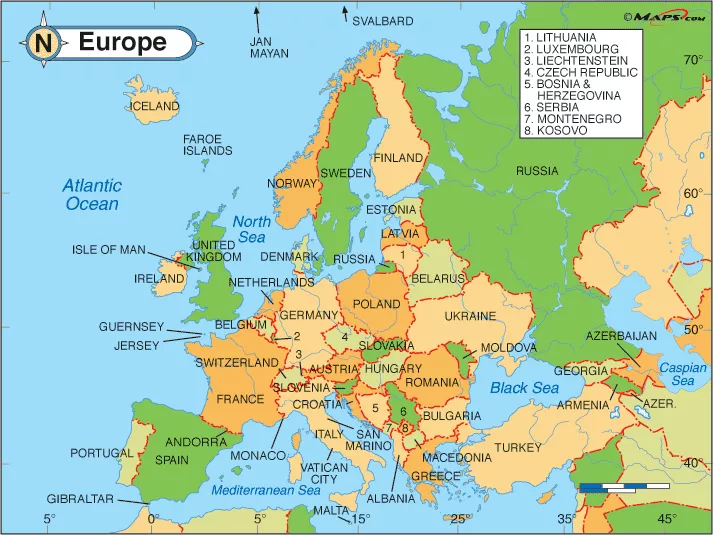
Europe has a total population of over 740 million people and is home to 44 countries, including Russia, France, Germany, and Italy. It is known for its rich history, diverse cultures, and stunning landmarks such as the Eiffel Tower, the Colosseum, and Big Ben.
Test your continent knowledge with our European geography quiz, Can You Name These European Landmarks?
Click on a country for a more detailed map, or try our map index.
History of Europe
Europe has a long and fascinating history, with evidence of human life dating back to the Paleolithic era. Over the centuries, many empires have risen and fallen in Europe, including the Roman Empire, the Byzantine Empire, and the Holy Roman Empire. Europe has also been the site of many major historical events, such as the French Revolution, World War I, and World War II.
In the 20th Century, Europe underwent seismic change. After the chaos and destruction from World War II, many countries were rebuilt, and the time of the strong European Union began. The Cold War cleaved the continent between the East and West, one side behind the Iron Curtain under Soviet influence, while Western Europe aligned itself with America and NATO. A turning point arrived with the fall of the Berlin Wall in 1989 and the reunification of Germany. Eventually, an old form of unified Europe changed to allow for future expansion by the European Union.
Today, the continent is a vibrant center of innovation, diplomacy and cultural interchange, but also one with its share of problems, including mass migration, climate change and political recalibration.
European Union
The European Union is a political and economic union of 27 member states located primarily in Europe. The EU was established in the aftermath of World War II to promote peace, stability, and economic cooperation among its members across the political map of Europe.
Geography of Europe
Europe reaches all the way from the icy tundra of the Arctic Circle in the north, to the dry, warm Mediterranean coast in the south, which brings varied climates and natural environments. The size of the continent is approximately 3.93 million square miles, which makes it the second smallest but most populous continent.
It features dramatic coastlines, fertile plains, and rugged mountains. Northern Europe has fjords and forests, while Southern Europe is about vineyards, olive groves and sunny coasts. The continent is home to several mountain ranges, including the Alps, the Ural Mountains, and the Carpathians. Europe also has several major rivers, including the Danube, the Rhine, and the Volga.
Tourist Attractions in Europe
There are countless tourist attractions in Europe, ranging from historic landmarks to natural wonders. Some of the most popular attractions include the following.
European Major Cities
According to the world map, Europe is home to many major and capital cities, including Paris, London, Berlin, Madrid, Rome, and Moscow. Each city has its own unique history, culture, and tourist sites.
The Alps
The Alps are a mountain range in central Europe that are known for their stunning natural beauty. Visitors can ski, hike, or simply enjoy the breathtaking views.
Mediterranean Sea
The Mediterranean Sea is a popular tourist destination, with beautiful beaches, historic towns, and delicious cuisine. Some of the most popular destinations include the French Riviera, the Amalfi Coast, and the Greek Islands.
The Baltic States
The Baltic states of Estonia, Latvia, and Lithuania are home to many historic and cultural attractions, including medieval castles, art museums, and gorgeous old town centers.
Best Tourist Attractions/Cities in Europe
Europe is full of destinations that will inspire your wanderlust, from ancient history and stunning art to world-class museums. Here are some of the continent’s most captivating highlights:
- Paris, France - The “City of Light,” the birthplace of the Eiffel Tower, the Louvre and Notre-Dame.
- Rome, Italy - The Eternal City: Steeped in history with sights such as the Colosseum, Roman Forum and Vatican City.
- London, England - Festival city, home to Buckingham Palace, Big Ben and the British Museum.
- Barcelona, Spain - Famous for Gaudí’s masterpiece, the Sagrada Família and a bustling beach scene.
- Amsterdam, Netherlands - Famous for its canals and cycling culture, and home to the Van Gogh Museum.
- Prague, Czech Republic - The “City of a Hundred Spires,” celebrated for its fairy-tale Old Town and Gothic allure.
- Athens, Greece - The cradle of democracy, home to the Acropolis and Parthenon.
- Swiss Alps, Switzerland - A place of wonders in nature where you can ski, hike and enjoy the breathtaking alpine environment.
- Iceland - Land of Fire and Ice with geysers, glaciers, volcanoes and the enchanted Northern Lights.
- Vienna, Austria - The city of music and culture, which hosted imperial palaces, grand opera houses and classical legacy.
Fun Facts About Europe
- Europe is the only continent with no deserts.
- Vatican City in Rome is the smallest country in the world.
- The continent is home to over 200 languages.
- Europe has more UNESCO World Heritage Sites than any other continent.
- The Trans-Siberian Railway, stretching across Russia, is the longest railway line in the world.

People Also Ask...
If you're inspecting a map of Europe, you may have some queries about the region. Here are some of the most frequently asked questions, along with their answers.
How Many Countries Are Exactly in Europe?
There are 44 countries in Europe, ranging from large countries like Russia and France to tiny city-states like Monaco and San Marino. The exact definition of "Europe" is somewhat vague, as some countries (such as Turkey) are partially located on the European continent but are generally considered to be part of Asia.
What are the 44 countries in Europe? The country maps of Europe are:
|
Romania
Russia San Marino Serbia Slovakia Slovenia Spain Sweden Switzerland Turkey Ukraine United Kingdom (England, Northern Ireland, Scotland, Wales) Vatican City |
Note: Cyprus and Kosovo are not included in this list, as Cyprus is geographically a part of Asia, and Kosovo, while being in the European continent, is only a partially-recognized independent state at the time of writing. However, some geographers do include them in the European countries' roster.
What Are the 5 Major Countries in Europe?
The "Big 5" countries in Europe are the five largest economies in the European Union: Germany, France, Italy, Spain, and the United Kingdom. These countries are also some of the most populous in Europe and are significant players in international politics and economics.
Is Russia a Part of Europe?
Russia is a country with territory in both Europe and Asia. Although the majority of its population and land area are located in Asia, about a quarter of its territory and population are located in Europe. Therefore, Russia is considered to be a transcontinental country with cultural, historical, and economic ties to both continents.
What Are the 7 Regions of Europe?
Europe can be divided into seven regions based on geography, history, and culture. These regions are Nordic Countries, Eastern Europe, Central Europe, Southern Europe, Western Europe, British Isles, and the Baltics. Each region has its own unique characteristics and traditions, making Europe a diverse and fascinating continent to explore.
What is the Biggest Country in Europe by Area?
Russia is the biggest country in Europe and occupies around 1.5 million square miles of the European part of the Ural Mountains. Add its Asian part, and Russia is easily the largest country in the world.
What is the Smallest Country in Europe?
The smallest European and world country is Vatican City, which is only 0.19 square miles. It is the capital of an independent city-state that clings to its famous guardianship: Rome, Italy.
What is the Longest River in Europe?
The Volga, the largest entirely within Russia, is Europe's longest river. It is about 2,194 miles long and a vital transportation, trade and hydroelectric power waterway.
What is the Highest Mountain in Europe?
Mount Elbrus, situated in the Caucasus range of mountains in Russia, is the Highest Mountain of Europe with an elevation of 5,642 meters (18,510 ft). It is a part of the Seven Summits.
What are the Most Spoken Languages in Europe?
The major languages spoken in Europe are Russian, German, French, Spanish and Italian. English is also popular as a second language across Europe.
What is the Oldest Country in Europe?
San Marino, founded in 301 AD, is the oldest surviving sovereign state in Europe. It has its own constitution and has maintained its independence for over 1,700 years.
What is Europe’s Most Visited City?
Paris, France, is the most visited city in Europe, attracting millions of tourists every year. It is known for its landmarks like the Eiffel Tower, the Louvre Museum, and Notre-Dame Cathedral.
Territory and Dependency Maps: Europe
More Geographic Information
|
|