Moldova Profile
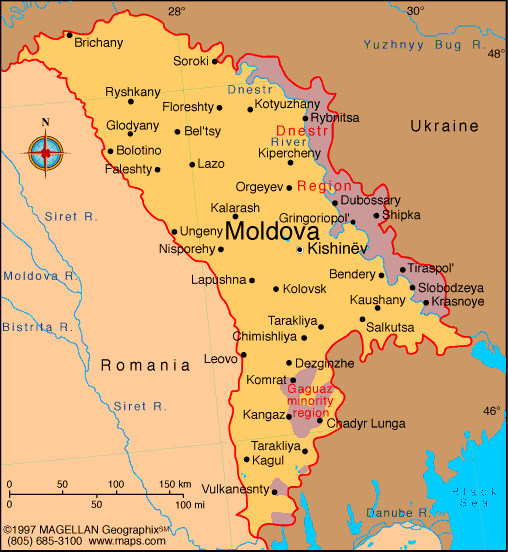
Moldova is a landlocked country in Eastern Europe, bordered by Romania to the west and Ukraine to the north, east, and south. A map of Moldova reveals a compact nation with rolling hills, rich farmland, and the Dniester River flowing along its eastern edge. While not large in area, Moldova’s geographic position has made it historically significant as a cultural and political crossroads between East and West.
Despite its small size, Moldova offers a blend of traditional rural life and developing urban centers. The country remains deeply rooted in agriculture while also expanding its wine industry and cultural tourism.
History of Moldova
The history of Moldova is shaped by centuries of shifting empires and regional conflict. Once part of the Principality of Moldavia, the territory changed hands multiple times under the Ottoman Empire, Russian Empire, and eventually became part of Romania in the early 20th century.
Following World War II, Moldova became one of the Soviet Socialist Republics. It gained independence in 1991 with the collapse of the USSR. Since then, Moldova has navigated political challenges, including the breakaway region of Transnistria, which remains a disputed area with limited international recognition.
Modern Moldova continues to develop its democratic institutions and maintain ties with both the European Union and its eastern neighbors.
Geography of Moldova
Moldova covers an area of about 33,846 square kilometers and is characterized by rolling plains, forested hills, and fertile valleys. Its climate is temperate continental with warm summers and cold winters.
-
Dniester River – A major river forming much of Moldova’s eastern border
-
Codri Hills – Central highlands rich in forest and biodiversity
-
Prut River – Forms the western border with Romania
-
Transnistria – A narrow strip along the east bank of the Dniester, self-declared autonomous region
Agriculture plays a central role in the economy due to the rich black soil, with grapes, fruits, grains, and vegetables as primary crops.
Major Cities
-
Chișinău – Capital and largest city, main cultural and economic hub
-
Tiraspol – Administrative center of the breakaway Transnistria region
-
Bălți – Industrial and cultural city in the north
-
Bender – Key town near the Dniester, historically significant
-
Cahul – Southern city near the Romanian border
-
Orhei – Known for historical monasteries and archaeological sites
Facts & Figures About Moldova
-
Area: Approximately 33,846 square kilometers
-
Population: Around 2.6 million
-
Capital: Chișinău
-
Official Language: Romanian
-
Other Languages: Russian, Gagauz, Ukrainian
-
Currency: Moldovan leu (MDL)
-
Independence: Declared in 1991 from the Soviet Union
-
Main Exports: Wine, fruits, vegetables, textiles
People also ask…
Where is Moldova located?
Moldova is in Eastern Europe, between Romania and Ukraine. It does not have a coastline.
What is Moldova known for?
Moldova is known for its wine production, scenic countryside, and as a former Soviet republic with a complex political landscape.
Is it safe to travel to Moldova?
Yes, Moldova is generally safe for tourists. Standard precautions are advised, especially when traveling near disputed regions like Transnistria.
What language is spoken in Moldova?
Romanian is the official language. Russian and Gagauz are also widely spoken in certain areas.
|
|
 |


