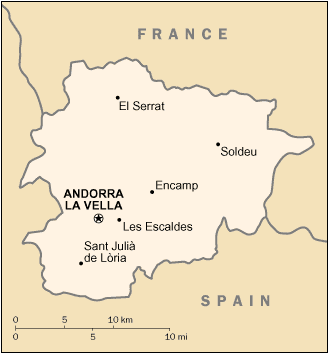
Andorra Profile
Nestled in the eastern Pyrenees between France and Spain, Andorra may be small, but it boasts a striking combination of natural beauty, rich history, and modern charm. From its capital, Andorra la Vella, to picturesque mountain villages and alpine valleys, the country blends medieval heritage with a contemporary, cosmopolitan vibe.
Home to around 77,000 people, Andorra is known for its snow-capped peaks, scenic hiking trails, and world-class ski resorts. Despite its compact size, the country offers a mix of cultural experiences, from historic churches and cobblestone streets to bustling shopping districts and vibrant local festivals.
With a strong economy driven by tourism, finance, and commerce, along with a proud cultural identity, Andorra proves that even a small nation can leave a big impression.
History of Aruba
Andorra has a long and distinctive history shaped by its mountain setting and strategic location between France and Spain. The area was originally settled in prehistoric times, with evidence of early human activity dating back thousands of years. Over time, it came under the influence of nearby Iberian and Roman cultures, though its remote valleys helped preserve local traditions and autonomy.
In the Middle Ages, the nation emerged as a unique political entity. In 1278, a historic agreement known as the Pareage established shared rule between the Count of Foix (later the French head of state) and the Bishop of Urgell in Spain. This arrangement laid the foundation for Andorra’s status as a co-principality, a system that still exists today.
For centuries, Andorra remained largely isolated, relying on agriculture, livestock, and trade across the Pyrenees. Modernization arrived slowly until the 20th century, when improved infrastructure and tourism transformed the country’s economy.
In 1993, the country adopted its first written constitution, officially becoming a sovereign parliamentary democracy while maintaining its co-princes. Today, Andorra is known for its political stability, high standard of living, and strong sense of national identity rooted in its medieval past.
Geography of Andorra
Andorra is a small, landlocked country located in the eastern Pyrenees Mountains. It is bordered by France to the north and Spain to the south, with no direct access to the sea. The country is mostly mountainous, with rugged peaks, narrow valleys, and fast-flowing rivers shaping its terrain.
Its high elevation creates dramatic scenery, with steep slopes, alpine meadows, and dense forests. The capital, Andorra la Vella, sits in one of the main valleys along the Valira River. The highest point is Coma Pedrosa, rising to 2,942 meters above sea level.
The terrain has a mountainous climate, with cold, snowy winters and mild summers. Snowfall supports winter sports, while the warmer months attract hikers and outdoor enthusiasts. Rivers, valleys, and mountains influence daily life, tourism, and the economy, giving Andorra its distinct alpine character.
Major Cities
-
Escaldes-Engordany
-
Encamp
-
Sant Julià de Lòria
-
La Massana
-
Ordino
-
Canillo
-
Pas de la Casa
-
Arinsal
-
El Tarter
Facts About Andorra
-
Highest Peak: Coma Pedrosa is the tallest mountain in Andorra, reaching 2,942 meters above sea level and offering stunning alpine views.
-
Cultural Heritage: Andorra has a unique co-principality government and blends Catalan, French, and Spanish cultural influences.
-
Rich Wildlife: The country’s mountains and forests are home to deer, marmots, eagles, and other alpine species thriving in protected natural areas.
-
Tourism and Economy: Tourism, skiing, hiking, and duty-free shopping form the backbone of Andorra’s economy, supported by its low-tax system and banking sector.
People also ask…
What languages are spoken in Andorra?
The official language of Andorra is Catalan, but Spanish, French, and Portuguese are also commonly spoken due to its location between France and Spain and its diverse population.
What is Andorra famous for?
Andorra is best known for its mountain scenery, ski resorts, and duty-free shopping. Its alpine terrain attracts tourists year-round for skiing, hiking, and outdoor activities.
What is the government system in Andorra?
Andorra is a parliamentary co-principality, meaning it is ruled by two co-princes, the President of France and the Bishop of Urgell in Spain, while a locally elected parliament handles most day-to-day governance.
What is traditional Andorran cuisine?
Traditional Andorran cuisine reflects Catalan and Pyrenean influences, featuring hearty mountain dishes. Popular foods include escudella, a rich meat and vegetable stew, trinxat, a mix of cabbage and potatoes, and cured meats like embotits. Cheese, fresh trout, game meats, and locally baked breads are also staples, and desserts often include nuts, honey, and pastries.
|
|
 |


