Minnesota Profile
Located in the Upper Midwest of the United States, Minnesota is a state of remarkable natural beauty and cultural richness. Known as the “Land of 10,000 Lakes,” it boasts an abundance of waterways, forests, and prairies, offering diverse landscapes from the rugged North Shore along Lake Superior to the serene countryside of southern Minnesota. With a population of over 5 million, the state blends vibrant urban centers like Minneapolis and Saint Paul with charming small towns and tight-knit rural communities.
Minnesota has a rich cultural and historical heritage, shaped by Native American tribes, Scandinavian and German immigrants, and more recent diverse communities. Its history is reflected in historic landmarks, museums, and festivals that celebrate both its indigenous roots and immigrant traditions.
For more detailed information, check out this comprehensive overview of Minnesota.
History of Minnesota
Long before European explorers arrived, the region was home to Native American tribes, primarily the Dakota (Sioux) and Ojibwe (Chippewa), who thrived along rivers and lakes, relying on fishing, hunting, and agriculture
In the 17th and 18th centuries, French explorers and fur traders arrived, establishing trading posts along the Mississippi River and Lake Superior. By the early 19th century, the U.S. acquired the land through treaties and purchases, leading to the creation of the Minnesota Territory in 1849. Just under a decade later, on May 11, 1858, Minnesota became the 32nd state of the United States.
The fertile land and natural resources attracted waves of European immigrants, especially Germans, Scandinavians, and Irish, who shaped the state’s culture, towns, and industries. Logging, mining, and agriculture thrived, while railroads connected communities and fueled economic growth.
Throughout the 20th century, Minnesota evolved into a hub of commerce, education, and culture. Cities like Minneapolis and Saint Paul became centers of innovation, while the state maintained its commitment to preserving natural beauty and outdoor recreation.
Geography of Minnesota
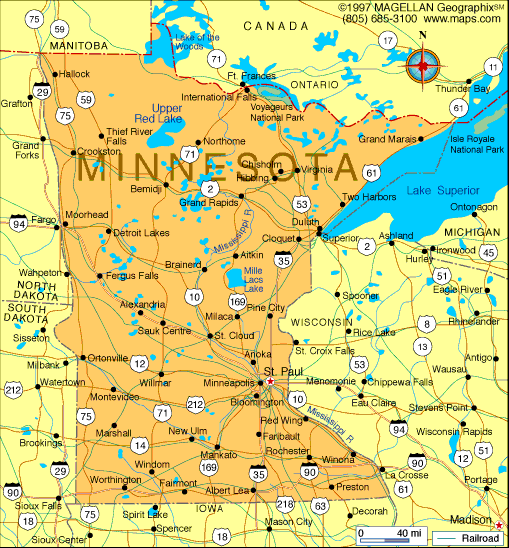
Minnesota is located in the Upper Midwest of the United States. It shares an international border with Canada to the north and is bordered by North Dakota and South Dakota to the west, Iowa to the south, and Wisconsin to the east. Covering approximately 86,936 square miles, the state features a diverse landscape of forests, prairies, and wetlands.
The state’s geography can be divided into three main regions: the Northern Lakes and Forests, the Central Minnesota Plain, and the Southern Minnesota Driftless and Prairie Region. The northern region is known for dense forests, rocky terrain, and countless lakes, while central Minnesota features rolling hills, fertile farmland, and numerous rivers. The southern region includes deep river valleys, bluffs, and prairies, supporting both agriculture and livestock.
Minnesota has a continental climate, with cold, snowy winters and warm, humid summers. Major rivers, including the Mississippi, Minnesota, and Red Rivers, play an important role in commerce, agriculture, and recreation. With its lakes, forests, plains, and river valleys, Minnesota offers a diverse and scenic landscape that defines the state’s natural beauty.
Major Cities
-
Plymouth
-
St. Cloud
-
Eagan
Facts about Minnesota
-
The Land of 10,000 Lakes: Minnesota is known for having over 11,000 lakes, earning its famous nickname.
-
The Twin Cities: Minneapolis and Saint Paul form one of the largest metropolitan areas in the Midwest.
-
The North Star State: Minnesota is nicknamed the North Star State, reflecting its northern location and guiding spirit.
-
Mall of America: Bloomington, Minnesota, is home to the Mall of America, the largest mall in the United States.
-
Boundary Waters Canoe Area: Northern Minnesota features this protected wilderness area, famous for canoeing, fishing, and camping.
-
State Fair: Minnesota hosts one of the largest state fairs in the U.S., known for its food, entertainment, and competitions.
-
Cultural Diversity: The state has a rich mix of Native American, Scandinavian, German, and other immigrant influences.
-
Prince’s Legacy: Minnesota is the birthplace of the legendary musician Prince, whose influence on music and culture worldwide is enduring.
People also ask…
What iconic dish is Minnesota famous for?
Minnesota is famous for hotdish, a hearty casserole typically made with meat, vegetables, and a starch like tater tots - a staple at family gatherings and potlucks.
What is Minnesota’s political landscape like?
Minnesota is considered a swing state in U.S. elections, with a history of voting for both Democratic and Republican candidates. It has a reputation for high voter turnout and active civic engagement.
What are some must-visit tourist attractions in Minnesota?
The state offers a variety of attractions, including the Mall of America in Bloomington, the wilderness of the Boundary Waters Canoe Area, the iconic Spoonbridge and Cherry at Minneapolis Sculpture Garden, the historic Split Rock Lighthouse on Lake Superior, and many more.
|
|
 |


