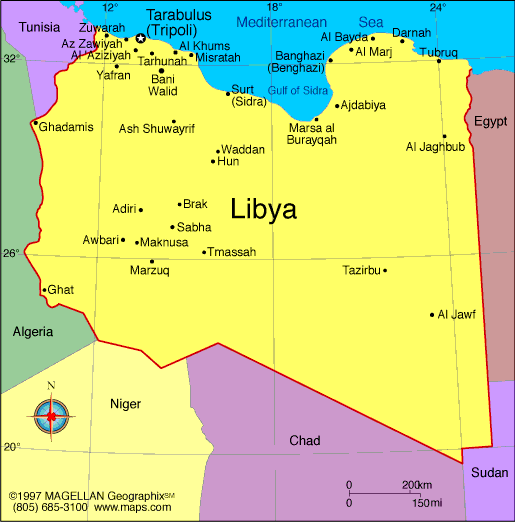
Libya Profile
Located in North Africa along the Mediterranean coast, Libya is a country of striking contrasts, from its vast Sahara Desert landscapes to historic coastal cities like Tripoli and Benghazi. With a population of over 7 million, most people live along the coast, where Mediterranean influences blend with desert traditions.
Libya has a rich history, having been home to ancient civilizations including the Phoenicians, Greeks, Romans, and Berbers, leaving behind a legacy of archaeological sites, ruins, and cultural heritage. Its unique mix of desert scenery, historic towns, and Mediterranean coastline gives Libya a distinctive place in Africa’s geography and history.
Find a detailed overview of Libya’s profile here.
History of Libya
The history of Libya stretches back thousands of years, shaped by its strategic location at the crossroads of Africa, the Mediterranean, and the Middle East. The region was originally inhabited by Berber tribes, who left a lasting mark on Libya’s culture and identity. Over time, the Phoenicians established trading posts along the coast, followed by the Greeks, who founded cities like Cyrene, and the Romans, whose rule brought roads, aqueducts, and urban centers that still exist as archaeological treasures today.
In the 7th century, Arab Muslim conquerors introduced Islam, which gradually became the dominant religion and cultural foundation. From the 16th to the 19th centuries, Libya fell under Ottoman rule, linking its cities to the wider Mediterranean and North African trade networks. In the early 20th century, Italy colonized Libya, modernizing parts of its infrastructure but also imposing harsh control, which sparked resistance and uprisings among local populations.
After World War II, the country gained independence in 1951 as the Kingdom of Libya, becoming the first country to achieve independence through the United Nations. In 1969, a coup led by Muammar Gaddafi transformed the country into a revolutionary state, shaping Libya’s politics and society for over four decades.
Since Gaddafi’s fall in 2011, Libya has faced political instability and conflict, but its rich historical layers, from ancient Berber tribes to Roman ruins and Islamic heritage, continue to define the nation’s unique identity.
Geography of Libya
Libya is a large, North African country bordered by Egypt to the east, Sudan to the southeast, Chad and Niger to the south, and Algeria and Tunisia to the west, with a northern coastline along the Mediterranean Sea. Its location gives it a mix of coastal plains, desert plateaus, and mountain ranges, making it one of Africa’s most geographically diverse nations.
Much of Libya is dominated by the Sahara Desert, featuring vast sand seas, rocky plateaus, and dry valleys. Along the northern coast, fertile plains and Mediterranean hills support agriculture and most of the country’s population, including major cities like Tripoli and Benghazi. The Cyrenaica region in the east is known for its limestone escarpments and ancient ruins, while the Fezzan region in the southwest is characterized by remote desert landscapes and oases.
Libya has a hot, arid climate, with scorching summers and mild winters along the coast. Rainfall is scarce, mostly confined to the northern Mediterranean strip, while the vast interior remains almost entirely desert. Temperatures can exceed 40°C (104°F) in summer, and sandstorms are common in the interior regions.
Major Cities
Interesting Facts About Libya
-
Ancient Civilization: Libya is home to some of the world’s most ancient civilizations, including the Greeks in Cyrenaica and the Romans, whose ruins can still be seen in cities like Leptis Magna and Sabratha.
-
Desert Dominance: Over 90% of Libya is covered by the Sahara Desert, making it one of the driest and most sparsely populated countries in the world.
-
Mediterranean Coastline: Libya has a long Mediterranean coastline of over 1,700 km, with fertile plains along the coast supporting the majority of the population.
-
Oil Wealth: Libya possesses some of the largest proven oil reserves in Africa, which have historically been the backbone of its economy.
-
Cultural Blend: Libya’s culture is a blend of Berber, Arab, Mediterranean, and African influences, visible in its languages, traditions, and architecture.
-
Extreme Temperatures: Inland desert regions can experience extreme heat, with summer temperatures frequently exceeding 40°C (104°F).
-
World Heritage Sites: The country boasts multiple UNESCO World Heritage sites, including the Roman cities of Leptis Magna and Sabratha, showcasing its rich historical legacy.
-
Restricted Tourism: While Libya has incredible historical and cultural sites, tourism is currently limited for safety reasons.
People also ask…
What languages are spoken in Libya?
The official language of Libya is Arabic, and Berber languages are also spoken by Indigenous communities. Italian and English are sometimes used in business or education, reflecting historical and international influences.
What is traditional Libyan cuisine?
Libyan cuisine is influenced by Mediterranean, Arab, and North African flavors, featuring dishes like couscous, bazeen (a type of dough served with meat or vegetables), grilled meats, seafood along the coast, and hearty stews. Dates, olives, and spices are commonly used, and tea and coffee are important social staples.
Is it safe to travel to Libya?
Libya is currently considered a high-risk travel destination due to political instability, armed conflicts, and security concerns. Most governments advise against non-essential travel, and tourism is very limited for safety reasons.
|
|
 |


