Mayotte Profile
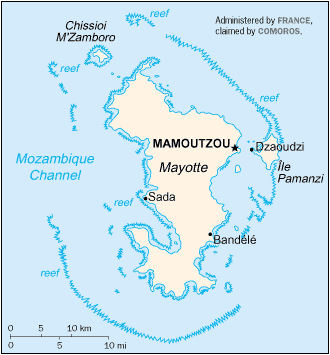
Mayotte is a unique island territory in the Indian Ocean, located between Madagascar and Mozambique, and is an overseas department of France. Covering just 374 square kilometers (144 square miles), it is home to over 300,000 people, making it one of the most densely populated islands in the region. Mayotte’s population reflects a rich mix of African, Malagasy, Arab, and French influences, giving the island a vibrant culture seen in its language, music, cuisine, and daily traditions.
The island is world-famous for its lagoon, it has the largest enclosed lagoon in the Indian Ocean, protected by a coral reef, which supports an incredible diversity of marine life, including whales, dolphins, and sea turtles.
Inland, Mayotte features volcanic hills, dense forests, rivers, and mangrove-lined coasts, offering plenty of opportunities for hiking, wildlife spotting, and ecotourism. Mayotte is a destination that combines adventure, relaxation, and cultural discovery in one small, extraordinary island.
History of Mayotte
Mayotte’s history is shaped by centuries of migration, trade, and cultural exchange, giving the island a unique identity within the region.
The first known settlers arrived between the 8th and 10th centuries and were of Austronesian and Bantu origin. They established farming and fishing communities and linked Mayotte to the wider Swahili world of East Africa. From the 11th century onward, Arab and Persian traders played a major role in the island’s development, introducing Islam and strengthening trade connections across the Indian Ocean. Local sultanates ruled the island during this period, influenced by neighboring islands in the Comoros.
In 1841, the island entered French control after being ceded to France by its ruler. Under colonial rule, the island was integrated into French administrative and economic systems, with plantation agriculture and new institutions reshaping local society.
During the 1970s, when the Comoros sought independence, Mayotte followed a different path. In a series of referendums, its population chose to remain part of France, leading to its separation from the newly independent Union of the Comoros in 1975. This decision was later confirmed in 2011, when Mayotte became an official French overseas department and part of the European Union.
Geography of Mayotte
The coastline of Mayotte is varied, with sandy beaches, rocky headlands, and mangrove-lined inlets. Mangroves are especially important along sheltered shores, helping to prevent erosion and serving as natural nurseries for marine species. Inland, the landscape becomes greener and more elevated, with volcanic soils that support agriculture and dense vegetation.
The archipelago has no land borders, as it is entirely surrounded by the waters of the Indian Ocean. Its edges are defined by the sea, lying at the northern end of the Comoros archipelago and separated from nearby islands and the African mainland by stretches of open ocean.
The climate is maritime tropical, characterized by warm temperatures throughout the year. The rainy season usually lasts from November to April, bringing heavy rainfall, high humidity, and the risk of cyclones. From May to October, the dry season offers cooler temperatures and more stable weather. There are amny lush plants, including forests, fruit trees, and crops such as bananas, cassava, and ylang-ylang.
Freshwater resources are limited, as the island has no large rivers, but many short streams flow from the central highlands toward the sea. These water sources are vital for farming and daily use, especially during the dry season.
Major Cities
-
Dzaoudzi
-
Pamandzi
-
Bandrele
-
Kani-Kéli
-
Chirongui
-
Mtsamboro
-
Ouangani
-
Sada
-
Bouéni
Interesting Facts About Mayotte
-
Coral Reef: Mayotte’s nearly continuous coral barrier shields the island from strong ocean waves and supports rich marine life.
-
Religion: Islam is the dominant religion, influencing daily life, traditions, and community culture.
-
Marine Life: Mayotte is home to diverse marine species, including sea turtles, dolphins, manta rays, and migrating whales.
-
Volcanic Origins: Mayotte was formed by ancient volcanic activity, shaping its hilly landscapes and fertile soils.
-
Youthful Population: Mayotte has one of the youngest populations in France, with a large proportion under the age of 20.
-
Ylang-Ylang: The island is known for growing fragrant ylang-ylang flowers, which are used to produce perfume.
-
Political Status: Mayotte chose to remain French while neighboring islands gained independence and is now France’s 101st department.
-
Cultural Mix: Mayotte reflects a blend of African, Malagasy, Arab, and European influences in its food, music, and traditions.
People also ask…
What is the cuisine of Mayotte?
Rice is a staple in Mayotte, often served with fish, chicken, or coconut-based sauces. Meals frequently include local vegetables, seafood, and aromatic spices.
What languages are spoken in Mayotte?
French is the official language, but Shimaore and Kibushi are widely spoken, reflecting the island’s African and Malagasy heritage.
What makes Mayotte’s lagoon special?
Mayotte’s lagoon is one of the largest enclosed lagoons in the world, protected by a coral reef and home to rich marine biodiversity, including dolphins, sea turtles, and whales.
|
|
 |


