Jan Mayen is a remote volcanic island in the Arctic Ocean, situated between Greenland and Norway. Administered by Norway, this isolated territory is home to striking landscapes dominated by the towering stratovolcano, Beerenberg. Though uninhabited by civilians, it plays a strategic and scientific role for Norway, hosting meteorological and military installations.
Due to its isolation, harsh climate, and rugged terrain, Jan Mayen is rarely visited and remains largely unknown to the general public. Yet, its position in the Greenland and Norwegian Seas gives it both geographic and geopolitical importance.
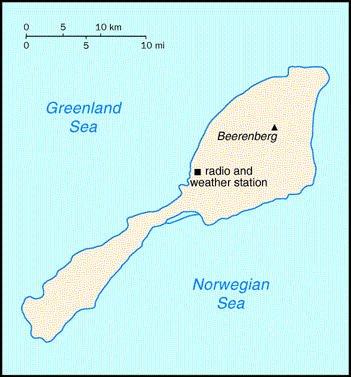
Jan Mayen Profile
History of Jan Mayen
Jan Mayen was likely known to whalers and sealers as early as the 17th century, with Dutch explorers naming the island after Jan Jacobszoon May, who sighted it in 1614. During the 1600s and 1700s, it served as a base for whaling operations due to its location near rich Arctic marine ecosystems.
The island became part of the Kingdom of Norway in 1929. It has no indigenous population or permanent civilian settlement. However, Norway established a meteorological station in the early 20th century and maintains military oversight of the island. Today, personnel rotate in and out to operate weather monitoring systems and maintain the station.
Geography of Jan Mayen
Jan Mayen covers around 377 square kilometers and is dominated by Beerenberg, the northernmost active volcano on Earth, standing at 2,277 meters. Glaciers and snowfields cover much of the island. The landscape includes steep cliffs, volcanic rock formations, and coastal lowlands.
It is divided into two parts: the narrower southern area known as Sør-Jan and the larger northern region where Beerenberg is located. The central isthmus connects these two regions. Due to the harsh Arctic climate, the island experiences strong winds, cold temperatures, and frequent cloud cover.
Access is limited to sea and occasional military flights, and there are no ports or civilian airports.
Facts & Figures About Jan Mayen
- Area: 377 square kilometers
- Population: No permanent residents; staffed by rotating personnel
- Country: Norway
- Main Feature: Beerenberg Volcano (2,277 meters)
- Climate: Arctic – cold, windy, and cloudy year-round
- Facilities: Meteorological station, military outpost, radio/weather station
- Strategic Importance: Weather monitoring, Arctic presence
- Protected Status: Part of Norway’s nature conservation efforts
- Access: Restricted; requires permission from Norwegian authorities
Key Installations
- Beerenberg: An active volcano, often snow-covered
- Weather Station: Operated by the Norwegian Meteorological Institute
- Radio and Military Post: Monitored by Norway’s Armed Forces
People also ask…
Is Jan Mayen inhabited?
Jan Mayen has no permanent civilian population. It is staffed year-round by rotating crews operating a weather station and military outpost.
Who owns Jan Mayen?
Jan Mayen is a territory of Norway. It has been under full Norwegian sovereignty since 1929.
Can you visit Jan Mayen?
Public access is highly restricted. Visits require special permission, usually granted for scientific, governmental, or military reasons. There are no ports or commercial facilities.
|
|
 |


