Nestled in the heart of Eastern Europe, Romania enchants visitors with its fairy-tale castles, mysterious forests, and vibrant folk traditions that have endured for centuries. From the medieval streets of Brașov to the rolling hills of Transylvania and the lively boulevards of Bucharest, Romania is a land where history, legend, and natural beauty intertwine.
With a population of nearly 19 million, Romania offers a captivating blend of old-world charm and modern vitality. The capital city, Bucharest, shines with its mix of grand architecture, trendy cafés, and buzzing nightlife. At the same time, regions like Transylvania, Maramureș, and Moldavia reveal ancient monasteries, traditional wooden villages, and breathtaking mountain landscapes.
From the legend of Dracula’s Castle to the tranquil waters of the Danube Delta, Romania invites travelers to uncover a world of natural wonder and mystery.
Discover more about Romania’s geography, history, and cultural heritage in our full guide.
Romania Profile
History of Romania
Romania’s history is a captivating story of ancient civilizations, powerful empires, and an enduring national spirit. The land that is now Romania has been inhabited since prehistoric times, with the Dacians, proud and resourceful people, forming one of Europe’s earliest kingdoms. In 106 AD, the Roman Empire conquered Dacia, leaving a lasting legacy in language, culture, and identity.
Through the Middle Ages, the regions of Wallachia, Moldavia, and Transylvania emerged as distinct principalities. Each played a vital role in preserving Romanian culture under the shadow of foreign powers like the Ottoman, Austro-Hungarian, and Russian Empires. Legendary leaders such as Vlad the Impaler (the inspiration for the Dracula myth) became symbols of resistance and courage.
In 1859, the unification of Wallachia and Moldavia laid the foundation for modern Romania, which gained full independence from the Ottoman Empire in 1877. The country expanded after World War I, forming Greater Romania, only to face upheavals during World War II and decades of Communist rule under Nicolae Ceaușescu.
Following the 1989 Revolution, Romania embraced democracy and market reforms, joining NATO in 2004 and the European Union in 2007. Today, it stands as a vibrant European nation.
Geography of Romania
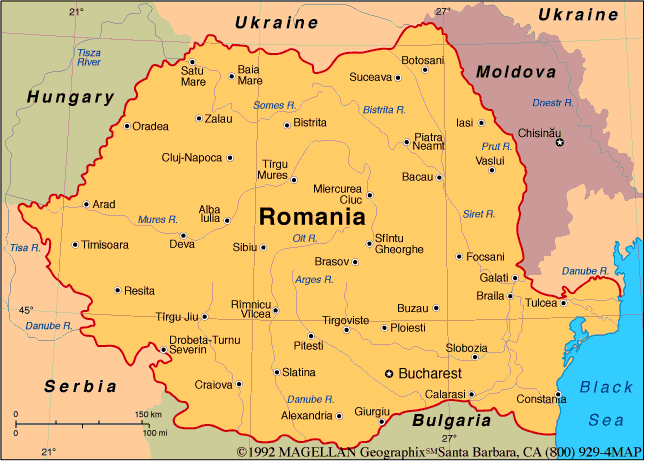
Romania is located in Eastern Europe and covers about 238,397 square kilometers (92,043 square miles). It shares borders with Ukraine to the north, Moldova to the northeast, Bulgaria to the south, Serbia to the southwest, and Hungary to the west. To the southeast, the country has a coastline along the Black Sea, offering ports and access to maritime trade.
The landscape is varied. The Carpathian Mountains stretch through the center and north, while the Apuseni Mountains rise in the west. Hills and plateaus spread out from these mountains toward the Danube River plains and the Danube Delta, Europe’s second-largest delta and a UNESCO World Heritage site.
Romania has a temperate-continental climate. Winters can be cold with snow in the mountains, while summers are warm, especially in the southern plains. Spring and autumn are short and mild. Major rivers such as the Danube, Mureș, and Prut are important for farming, transport, and industry across the country.
Major Cities
- Bucharest
- Cluj-Napoca
- Timișoara
- Iași
- Constanța
- Craiova
- Brașov
- Galați
- Ploiești
- Oradea
Interesting Facts about Romania
- Land of Castles: Romania is home to over 1,400 castles and fortresses, including the famous Bran Castle, often linked to the Dracula legend.
- Largest Underground Salt Mine: The Salina Turda salt mine is a historic site turned into an underground attraction with a lake, amusement area, and museum.
- Home of the Carpathians: The Carpathian Mountains cover about 30% of Romania, providing habitats for bears, wolves, and lynx.
- Danube Delta: Romania contains the Danube Delta, Europe’s second-largest river delta, a UNESCO World Heritage site, and a birdwatcher’s paradise.
- Oldest Human Settlement in Europe: Evidence of humans in Romania dates back over 40,000 years, including ancient caves and prehistoric artifacts.
- Rich Folk Traditions: Romania preserves folk dances, music, and crafts, with colorful festivals throughout the year.
- Transylvania Legends: The region of Transylvania is associated with Dracula and medieval legends, drawing tourists worldwide.
- World’s Heaviest Building: The Palace of the Parliament in Bucharest is the heaviest and one of the largest administrative buildings in the world.
- Merry Cemetery: In Săpânța, local traditions include a cemetery with colorful tombstones that celebrate the lives of the deceased with humorous epitaphs.
- Home of the Black Sea Coast: Romania has a Black Sea coastline with resorts like Mamaia, popular for summer tourism and water sports.
People also ask…
What Currency is Used in Romania?
Romania uses the Romanian leu (RON) as its official currency.
What is Romania famous for?
Romania is famous for its castles, including Bran Castle linked to Dracula, the Carpathian Mountains, the Danube Delta, and rich folk traditions.
What language is spoken in Romania?
The official language is Romanian, a Romance language closely related to Italian, French, Spanish, and Portuguese.
|
|
 |


