Iceland, officially known as the Republic of Iceland, is a Nordic island nation located in the North Atlantic Ocean. Known as the “Land of Fire and Ice,” it is famous for striking contrasts, where active volcanoes rise beside glaciers, and steaming hot springs bubble beneath snow-covered peaks.
Despite its remote location, Iceland has a population of about 399,788 people, according to the latest 2025 statistics, and is celebrated for its strong cultural heritage, modern society, and commitment to sustainability.
From the colourful capital of Reykjavík to the deep fjords, geysers, volcanic scenery, and waterfalls, Iceland offers travellers a majestic taste of nature at its most extreme. With its diverse cultural heritage and extraordinary natural beauty, it ranks among Europe’s most exceptional destinations.
If you wish to learn more details about Iceland, you can check this detailed guide.
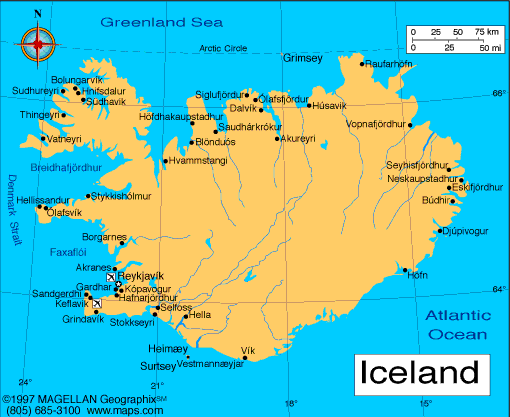
Iceland Profile
History of Iceland
Iceland was first settled by Norse explorers from Norway and the British Isles around 870 CE. The early inhabitants formed a unique society governed by the Althing, which was founded around 930 CE and recognized as the world’s oldest functioning parliament.
Norway and Denmark ruled Iceland during the Middle Ages, and its economy was based on fishing and farming. The island faced harsh conditions, including volcanic eruptions, severe winters, and occasional famines, which shaped its resilient culture.
Iceland achieved its independence from Denmark in 1918, becoming a sovereign kingdom which lasted until the end of the German occupation of Denmark. In 1944, the country declared its complete independence as a republic.
Today, Iceland is associated with strong democratic values, world-renowned literature, and renewable energy sources and environmental protection.
Geography of Iceland
Iceland is a volcanic island nation in the North Atlantic Ocean, slightly below the Arctic Circle. It lies on the Mid-Atlantic Ridge, where the tectonic plates of North America and Eurasia are moving apart, making it one of the most geothermally active places on Earth. This process has resulted in a dramatic landscape featuring volcanic activity, geysers, hot springs, lava fields, and glaciers.
Iceland has no land borders, but it is located 287 kilometers (178 miles) east of Greenland and 970 kilometers (600 miles) west of Norway. Fjords characterize its coastline.
The climate is subarctic or cold oceanic, with mild to warm summers and chilly winters, often moderated by the Gulf Stream. Coastal areas experience relatively mild winters and cool summers, while the interior highlands remain colder. Despite the country’s northern latitude, the climate allows a mix of tundra, moss-covered lava fields, and small forests in some sheltered areas.
The majority of Iceland’s population lives along the coast, especially in and around Reykjavík, which is the capital and cultural centre. Other notable towns include Kópavogur, Hafnarfjörður, and Akureyri (the largest city in the north), as well as Reykjanesbær (combined with Keflavík), where the international airport is located.
Major Cities
- Reykjavík
- Kópavogur
- Hafnarfjörður
- Akureyri
- Reykjanesbær
- Garðabær
- Mosfellsbær
- Akranes
- Selfoss
Tourist attractions
Iceland is home to various famous natural wonders. Some famous landmarks like Pingvellir National Park, where the North American and Eurasian plates meet, the Geysir geothermal area, where you will see Strokkur geyser erupting, and Gullfoss waterfall.
Other highlights include the Blue Lagoon, a geothermal spa near Grindavík, Vatnajökull National Park, which is home to Europe’s largest glacier, and the Jökulsárlón Glacier Lagoon, known for its drifting icebergs.
Those sites, along with Iceland's volcanoes, black-sand beaches, and northern lights, make it one of the most extraordinary places on earth.
Interesting Facts about Iceland
- No Forests, Yet Reforestation Efforts Continue: When Vikings first arrived, much of Iceland was covered in birch forests, but centuries of farming and grazing cleared most of them. Today, the country is actively replanting trees to restore its natural landscape.
- Home to the World’s Oldest Parliament: The Althing, established around 930 CE at Pingvellir, is the world’s oldest continuously operating parliament.
- Powered Almost Entirely by Renewable Energy: About 85–90% of Iceland´s energy is provided from renewable sources, primarily geothermal and hydroelectric power.
- No Mosquitoes: Despite its wetlands and temperate climate, Iceland has no native mosquito species.
- Names Follow Ancient Traditions: Many Icelanders do not have conventional family surnames. Instead, last names are derived from a person’s father’s first name and the suffixes -son (son of) or -dóttir (daughter of).
- You Can See the Northern Lights and the Midnight Sun: Depending on the season, Iceland gets almost 24 hours of daylight in summer and long nights in winter, with darkness ideal for seeing the Aurora Borealis.
- Vikings were the First Settlers: The island was home to Norse explorers from Scandinavia who settled there around 870 CE, making it one of the last large landmasses in Europe to be inhabited.
- No McDonald’s or Army: Iceland has no standing army and closed its last McDonald’s restaurant in 2009.
- Hot Water Comes Straight from the Ground: Thanks to abundant geothermal activity, hot water used for heating and bathing is piped directly from natural springs.
- Elves and Hidden People in Folklore: Many Icelanders still hold a fond belief in huldufólk (“hidden people” or elves), and some roads and building projects have even been redirected away from what locals believe to be elven homes.
People also ask…
What are Some Significant Cultural or Natural Highlights of Iceland?
Iceland is known for its volcanoes, glaciers, geysers, waterfalls, and hot springs. Among the key cultural assets are the Althing, the oldest parliament in the world, and the tradition of poetry composed in regional medieval manuscripts known as sagas. The Aurora and the Midnight Sun are also natural phenomena that draw significant attention.
What is the Currency of Iceland?
The official currency of Iceland is the Icelandic króna (ISK). Coins and banknotes are used, and credit cards are accepted throughout the country.
What is Traditional Icelandic Cuisine?
The country’s Nordic heritage influences Icelandic cuisine, which includes dishes such as lamb, fresh fish, skyr (a thick, yogurt-like dairy product), and traditional delicacies like hákarl (fermented shark). Seafood is particularly abundant and central to the diet.
What Language do People Apeak in Iceland?
The official language is Icelandic, which is a North Germanic language closely related to Old Norse. English is also widely spoken.
|
|
 |


