Located in northern Europe, Norway has one of the most beautiful landscapes in the world. It boasts amazing natural scenery, with its rugged coastlines, majestic fjords, and vast forests. The country is a constitutional monarchy, and its capital city, Oslo, is known for its rich history and cultural diversity.
Norway combines a progressive society with a high standard of living and great concern for sustainability. All these facts make it a modern world’s shining example of living well while maintaining long-standing traditions.
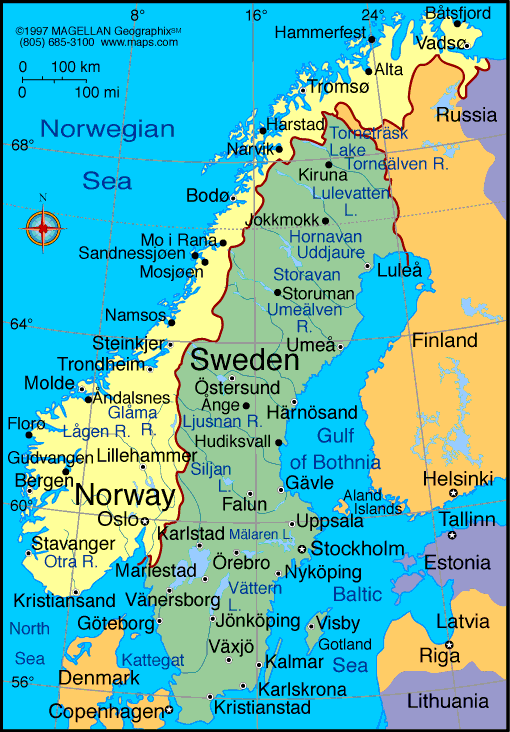
Norway Profile
History of Norway
Norway has a long and rich history dating back to the early Viking Age, about the 8th century, during which Norse sailors began raiding and trading throughout Europe. The
Vikings settled in places such as England, Iceland, and North America, and their influence helped shape early Norwegian society.
The 11th century saw Norway emerge as a Christian kingdom, led by King Olaf II, later a saint. Norway was unified in the Middle Ages as the Kingdom of Norway, but in the late 14th century, it fell into a union with Denmark that would last for centuries.
Norway became fully independent in 1905 after the break-up of the union with Sweden. Before that, it was ceded to Sweden after the Napoleonic Wars in 1814. The country remained neutral during World War I, but it was invaded by Nazi Germany in World War II and occupied for five years. After that, Norway helped found the United Nations and, later, the North Atlantic Treaty Organization (NATO).
Nowadays, no country is more associated with having a well-developed economy (especially in oil and gas extraction) than Norway. No other country can be said to have downplayed anti-communism quite as thoroughly as this Scandinavian kingdom, despite the need for an extensive territorial threat to its national point of reference.
Geography of Norway
Norway may be found in Scandinavia, in Northern Europe, covering the 61st largest land mass in the world at about 148,729 square miles (384,000 square kilometers). To the north, it shares land borders with Finland and Russia, and to the east - with Sweden. The North Atlantic Ocean laps Norway’s western coast, leading to a rugged coast filled with stunning fjords, islands, and natural harbors. It is dominated by mountains, forests, and glaciers, which account for some of its most striking landscapes globally.
Norway features a dramatic coastline and deep fjords, such as the Geirangerfjord and Sognefjord, which are both UNESCO World Heritage sites. The geographical location of the country creates a wide range of climates. The coastline is affected by the Gulf Stream and is relatively cool, while the inland regions and northern mountains can be colder, particularly in winter.
Major Cities in Norway
Oslo: The capital and largest city in Norway, which is known as an economic center of the country that focuses on sustainability and modern development. Here you can find some world-class museums, such as the Vigeland Sculpture Park and the Munch Museum.
Bergen: Positioned on Norway’s western coast and surrounded by beautiful mountains, Bergen is the second-largest city. The area is famous for its stunning waterfront and historic UNESCO World Heritage Site - the Bryggen district.
Stavanger: Positioned in the southwestern region, the city is a leader in the oil industry. Famous for its charming wooden houses and old town, Stavanger embraces history with modernity.
Trondheim: Located in central Norway, it is one of the oldest cities in the country and, importantly, the old capital of Norway during the Viking Age. One of the city’s defining features is the Nidaros Cathedral, an impressive Gothic structure that has attracted pilgrims for centuries. Trondheim is also home to NTNU (Norwegian University of Science and Technology), meaning there is a vibrant student-oriented feel.
Drammen: A vibrant riverfront city that also plays an important role in the cultural development of Norway. There are many galleries, theaters, and a great variety of events during the year.
People also ask…
What languages are spoken in Norway?
Norwegian (Bokmål and Nynorsk — two written forms) and Sami (in some areas) are the official languages of Norway. English is also a widely-spoken language, particularly in cities and among younger people.
What is the main currency in Norway?
The official currency of Norway is the Norwegian krone (NOK). Most areas accept credit cards, and digital payments are common across the country.
Is Norway safe to visit?
Generally, Norway is believed to be very safe. Crime is uncommon and crime rates are very low. Still, it’s always advisable to take standard precautions, just like in any other country.
What is the population of Norway?
According to the most recent figures, Norway has about 5,610,976 inhabitants. The population distribution is uneven, as the majority is concentrated in urban cities, including the major cities of Oslo, Bergen, and Stavanger.
What is Norway known for?
Norway is known for stunning natural scenery such as fjords, mountains, and the Northern Lights. It has a rich history, from its Viking heritage to its art and literature contributions.
What are some fun facts about Norway?
- Norway Has the World's Longest Road Tunnel - The Lærdal Tunnel. It has a length of over 15 miles and it serves as a convenient underground route through the numerous mountains.
- The famous Midnight Sun can be observed in Norway. This is due to the geographic location and the fact that the sun doesn’t set for weeks during the summer.
- Norway is home to more than 50,000 Islands, which makes it one of the most dense island countries in the world.
What is the cuisine in Norway?
Norwegians like to consume fresh, local ingredients like fish, meats, potatoes and dairy products. Traditional dishes include smoked salmon, lutefisk (dried fish), and kjøttkaker (meatballs served with potatoes and gravy).
What is the tallest mountain in Norway?
Galdhøpiggen, located in the Jotunheimen Mountains, is the highest peak in Norway. It is 2,469 meters (8,100 feet).
Is Norway a member of the European Union?
Norway is not a member of the European Union, however, it is part of the EEA, which means it can have access to the single market and many other benefits.
What are some top tourist attractions in Norway?
Norway boasts beautiful natural attractions, such as the Geirangerfjord, the Lofoten Islands, and the Sognefjord. Cities like Oslo also have plenty of cultural points to see, including the Viking Ship Museum and the Munch Museum.
What is the political system in Norway?
Norway is a constitutional monarchy with a parliamentary system. The King is the head of state in a ceremonial capacity, and the prime minister and parliament run the government.
|
|