France Profile
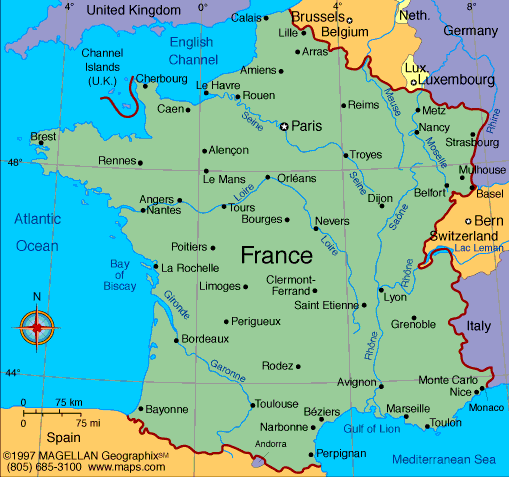
France is a major country in Western Europe, bordered by Belgium, Luxembourg, Germany, Switzerland, Italy, Monaco, Spain, and the Atlantic Ocean, Mediterranean Sea, and English Channel. A map of France shows a nation with highly varied landscapes, ranging from coastal plains and fertile river valleys to mountain ranges and alpine peaks. France also includes several overseas regions and territories across the Caribbean, South America, and the Indian and Pacific Oceans.
France plays a central role in European history, politics, and culture. It is one of the founding members of the European Union and remains a global influence in diplomacy, art, cuisine, and fashion. Paris, the capital, is one of the most visited cities in the world.
History of France
France’s history stretches back to ancient Gaul, which was conquered by the Roman Empire in the first century BC. Following the fall of Rome, the region developed into the Kingdom of France, becoming a powerful medieval state under rulers such as Charlemagne and later the Capetian kings.
The French Revolution in 1789 marked a turning point, overthrowing the monarchy and establishing republican ideals that influenced political movements worldwide. France experienced further transformation through the Napoleonic era, two world wars, and decolonization. Today, it is a stable republic with a strong national identity and global reach.
Geography of France
France covers approximately 551,695 square kilometers in Europe, making it one of the largest countries on the continent. Its geography is highly diverse:
-
Northern and Western Plains: Fertile agricultural regions and river valleys
-
Atlantic Coast: Long sandy beaches and rugged cliffs
-
Mediterranean Coast: Warm climate and rocky shoreline in the south
-
Mountain Ranges: The Alps, Pyrenees, Massif Central, Jura, and Vosges
-
Major Rivers: Seine, Loire, Rhône, Garonne, and Rhine
The highest point in Western Europe, Mont Blanc, lies in the French Alps near the Italian border. France has a temperate climate overall, with regional variation influenced by latitude, altitude, and proximity to the sea.
Major Cities
-
Paris: Capital and cultural, political, and economic center
-
Marseille: Major Mediterranean port city
-
Lyon: Historic city and culinary capital
-
Toulouse: Aerospace and technology hub
-
Nice: Coastal city on the French Riviera
-
Nantes: Atlantic port and regional capital
-
Strasbourg: European institutional center near the German border
-
Bordeaux: Famous for wine production and architecture
Facts & Figures About France
-
Area: 551,695 square kilometers (European France)
-
Population: Around 68 million
-
Capital: Paris
-
Official Language: French
-
Currency: Euro (EUR)
-
Government Type: Republic
-
EU Membership: Founding member
-
Highest Point: Mont Blanc at 4,808 meters
-
Major Industries: Tourism, aerospace, agriculture, automotive, luxury goods
People also ask
Where is France located?
France is located in Western Europe, with coastlines on the Atlantic Ocean, English Channel, and Mediterranean Sea, and borders with seven European countries.
What is France best known for?
France is known for its history, art, cuisine, fashion, wine, architecture, and global cultural influence.
How many regions are in France?
France has 18 regions in total, including 13 metropolitan regions in Europe and 5 overseas regions.
What language is spoken in France?
French is the official language, though regional languages such as Breton, Occitan, and Alsatian are spoken in some areas.
|
|
 |


