Hungary Profile
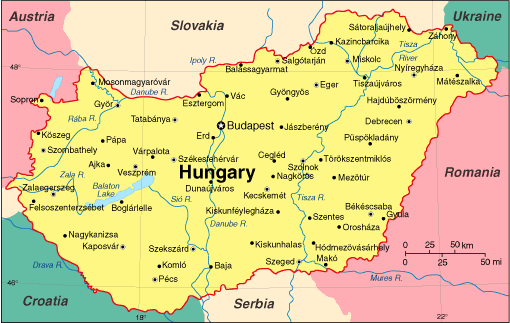
Hungary is a landlocked nation in Central Europe bordered by Austria, Slovakia, Ukraine, Romania, Serbia, Croatia, and Slovenia. Located in the Carpathian Basin, the country is known for its rolling plains, historic cities, thermal baths, and rich cultural traditions. Hungary is a member of the European Union and has grown into a vibrant hub for tourism, commerce, and the arts.
History of Hungary
Hungary’s history begins with the Magyar tribes who settled the Carpathian Basin in the 9th century. The Kingdom of Hungary was established in 1000 AD and became a significant power in medieval Europe. Over the centuries, it experienced rule under the Ottomans, Habsburgs, and later became part of the Austro-Hungarian Empire.
Following the empire’s collapse after World War I, Hungary lost much of its territory through the Treaty of Trianon. It later came under Soviet influence after World War II, becoming a socialist republic until the democratic transition in 1989. Today, Hungary is a parliamentary republic with a strong national identity and historical legacy.
Geography of Hungary
Hungary covers an area of roughly 93,000 square kilometers. The terrain is mostly flat to rolling plains, especially in the Great Hungarian Plain (Alföld) in the east and southeast. The western and northern parts include hills and low mountains, such as the Transdanubian Hills and the North Hungarian Mountains.
The Danube River divides the country almost in half from north to south, while the Tisza River flows through the eastern regions. Lake Balaton, the largest freshwater lake in Central Europe, is a key geographical and tourist landmark in western Hungary.
The climate is continental with cold winters, warm summers, and moderate rainfall throughout the year.
Facts & Figures About Hungary
-
Area: Approximately 93,000 square kilometers
-
Population: Around 9.6 million
-
Capital: Budapest
-
Borders: Austria, Slovakia, Ukraine, Romania, Serbia, Croatia, Slovenia
-
Official Language: Hungarian
-
Currency: Hungarian forint (HUF)
-
EU Membership: Since 2004
-
Major Rivers: Danube, Tisza
-
Key Landmarks: Lake Balaton, Hortobágy National Park, Buda Castle, Parliament Building
Major Cities
-
Budapest – The capital and largest city, known for its architecture, spas, and Danube views
-
Debrecen – A major cultural and academic center in eastern Hungary
-
Szeged – Known for its universities and lively festivals
-
Miskolc – Industrial city near the Bükk Mountains
-
Pécs – Historic southern city with Roman ruins and a Mediterranean vibe
-
Győr – A dynamic city in northwest Hungary, close to Austria and Slovakia
-
Nyíregyháza – A regional hub in the northeast
People also ask…
Is Hungary a safe country to visit?
Yes. Hungary is generally considered safe for tourists. Standard precautions should be taken, especially in crowded areas or at night.
What is Hungary famous for?
Hungary is known for its thermal baths, paprika, classical music, unique language, and vibrant capital city, Budapest.
What language is spoken in Hungary?
Hungarian is the official language. It is a Uralic language unrelated to most European languages and is known for its complexity and uniqueness.
|
|
 |


