Greece Profile
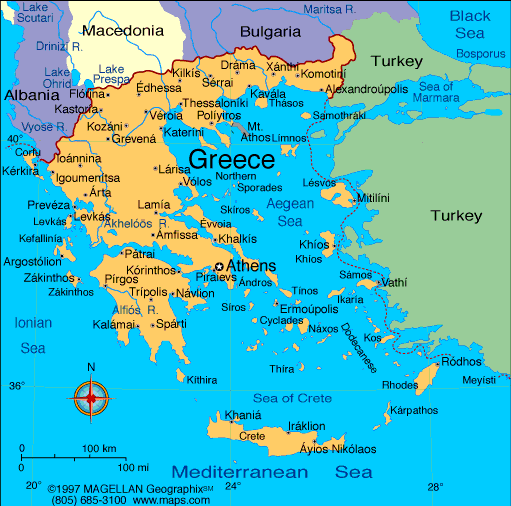
Greece is located in southeastern Europe at the crossroads of Europe, Asia, and Africa. A map of Greece shows a country made up of a mountainous mainland and thousands of islands spread across the Aegean and Ionian Seas. It borders Albania, North Macedonia, Bulgaria, Turkey, and is surrounded by the Mediterranean Sea.
Known as the birthplace of democracy, Western philosophy, and the Olympic Games, Greece has had a lasting influence on global culture and history. Its varied geography includes rugged mountains, fertile valleys, long coastlines, and some of the most recognizable islands in the world.
History of Greece
Greece’s history dates back thousands of years to ancient civilizations such as the Minoans and Mycenaeans. Classical Greece flourished during the 5th century BC, producing influential thinkers like Socrates, Plato, and Aristotle, and establishing city-states such as Athens and Sparta.
The region later became part of the Roman and Byzantine Empires, followed by centuries of Ottoman rule. Greece gained independence in 1830 after a successful war of independence. In the modern era, Greece became a republic and joined the European Union in 1981, while continuing to preserve its deep historical and cultural identity.
Geography of Greece
Greece covers approximately 131,957 square kilometers and has one of the longest coastlines in Europe. The terrain is largely mountainous, with ranges such as the Pindus Mountains running through the mainland.
Key geographic features include:
-
Mainland Greece: Mountainous interior with coastal plains
-
Peloponnese Peninsula: Connected to the mainland by the Isthmus of Corinth
-
Greek Islands: Over 6,000 islands and islets, with about 200 inhabited
-
Major Seas: Aegean Sea, Ionian Sea, Mediterranean Sea
-
Highest Point: Mount Olympus, rising to 2,917 meters
Greece has a Mediterranean climate, with hot, dry summers and mild, wetter winters, especially along the coast and islands.
Major Cities
-
Athens: Capital city and historical heart of the country
-
Thessaloniki: Major port and cultural center in northern Greece
-
Patras: Important city in western Greece
-
Heraklion: Largest city on the island of Crete
-
Larissa: Agricultural and commercial hub in central Greece
-
Volos: Coastal city near Mount Pelion
-
Ioannina: Regional center in northwestern Greece
Facts & Figures About Greece
-
Area: 131,957 square kilometers
-
Population: Around 10.4 million
-
Capital: Athens
-
Official Language: Greek
-
Currency: Euro (EUR)
-
Government Type: Parliamentary republic
-
EU Membership: Since 1981
-
Number of Islands: Over 6,000
-
Major Industries: Tourism, shipping, agriculture, food production
People also ask
Where is Greece located on the map?
Greece is located in southeastern Europe, bordered by Albania, North Macedonia, Bulgaria, and Turkey, with coastlines on the Aegean, Ionian, and Mediterranean Seas.
What is Greece known for?
Greece is known for its ancient history, mythology, philosophy, islands, cuisine, and role in shaping Western civilization.
How many islands does Greece have?
Greece has more than 6,000 islands and islets, although only about 200 are inhabited.
What language is spoken in Greece?
Greek is the official language and has been spoken in the region for thousands of years.
|
|
 |


