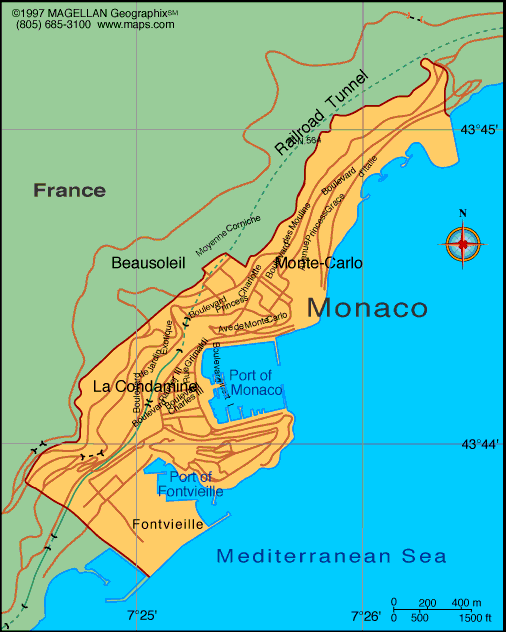
Monaco is a sovereign city-state located on the French Riviera in Western Europe. A map of Monaco reveals a narrow coastal stretch along the Mediterranean Sea, nestled between southeastern France and Italy. Despite being just over 2 square kilometers in size, Monaco is one of the most densely populated and wealthiest nations in the world.
Monaco is known for luxury, high-stakes finance, and international events like the Monaco Grand Prix. The principality’s map shows a compact yet strategically positioned country made up of several districts, each with distinct character and purpose.
Monaco Profile
History of Monaco
Monaco’s history traces back to ancient times, but its modern identity began in 1297 when the Grimaldi family seized control of the fortress overlooking the harbor. The Grimaldis have ruled Monaco almost continuously ever since, shaping it into a powerful microstate.
In the 19th century, Monaco lost much of its territory to France, but it reinvented itself through tourism and gambling, opening the world-famous Monte Carlo Casino in 1863. Since then, Monaco has attracted royalty, celebrities, and investors from around the globe. The country strengthened its sovereignty with new treaties in the 20th century while maintaining a close relationship with France.
Today, Monaco is a global financial hub, known for its tax policies, prestige, and political stability under Prince Albert II.
Geography of Monaco
Monaco is the second smallest country in the world, covering just 2.02 square kilometers. It is entirely urbanized and situated on the Mediterranean coast between Nice and the Italian border. Despite its size, the terrain includes rocky hills, built-up slopes, and reclaimed land from the sea.
- Borders: France on three sides, the Mediterranean Sea on the fourth
- Elevation: Varies from sea level to 164 meters at Mont Agel
- Climate: Mediterranean — warm, dry summers and mild, wet winters
- Land Use: Virtually all land is developed for residential, commercial, or government use
- Expansion: Includes extensive land reclamation projects, such as Portier Cove
Major Districts
- Monte Carlo – The most famous district, home to the casino, luxury hotels, and Formula 1 circuit
- La Condamine – The port area, centered around Port Hercule
- Fontvieille – A newer district built on reclaimed land, known for its marina and sports venues
- Monaco-Ville (Le Rocher) – The old town, location of the royal palace and historic center
- Larvotto – Seaside area known for its beach and high-end residences
- Moneghetti – Residential area near the western border with France
- Jardin Exotique – Named after the famous botanical garden with views over the coast
Facts About Monaco
- Monaco has no income tax for residents
- It is a constitutional monarchy ruled by the House of Grimaldi
- The official language is French, though Italian and English are widely spoken
- The euro is the official currency, despite not being in the EU
- Monaco has one of the highest GDP per capita in the world
- The population is around 39,000, but over 70% are foreign nationals
- Monaco has no airport; it is accessible via Nice and helicopter transfer
- The Monaco Grand Prix is one of the most prestigious Formula 1 races
People Also Ask
Where is Monaco located on a map?
Monaco is located on the northern coast of the Mediterranean Sea, bordered by France to the north, east, and west, near the Italian border.
Is Monaco its own country?
Yes. Monaco is a fully independent sovereign city-state and the second smallest country in the world.
What is Monte Carlo in Monaco?
Monte Carlo is a district within Monaco, famous for its luxury casino, hotels, and glamorous lifestyle. It is often mistaken as the name of the country itself.
What makes Monaco unique?
Monaco is unique for its size, wealth, tax system, royal heritage, and international status as a hub for finance, sports, and luxury living.
|
|
 |


