Austria, officially the Republic of Austria, is a landlocked country in Central Europe, renowned for its alpine scenery, Imperial history, and sophisticated culture.
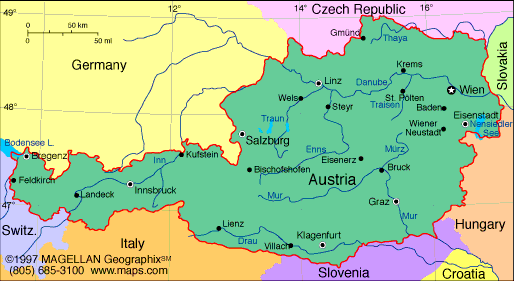
Nestled between Germany, the Czech Republic, Slovakia, Hungary, and Slovenia, and sharing borders with Italy and Switzerland, Austria is in the centre of Europe, a melting pot of cultures, languages, and traditions.
Austria has a population of approximately 9.1 million, making it one of the smaller countries in Central Europe. Still, you may be enticed by its stunning Alpine peaks and crystal-clear lakes, historic cities, or sumptuous cake shops.
The country features a rich tapestry of landscapes – from the stunning imperial grandeur of its capital, Vienna, to the soul-stirring silhouettes of snowcapped peaks that stretch into the sky along the border with Switzerland. Among its many claims to fame as one of the homes of classical music (Mozart, Beethoven, and Schubert all hailed from here), as well as a playground for skiers, hikers, and history buffs, Austria continues to captivate visitors with a blend of regal charm and natural beauty.
To explore more fascinating details about Austria and other nations around the world, visit our Countries of the World section.
Austria Profile
History of Austria
Austria is a politically fascinating country, with a more than 3,000-year-old history as a key crossroads in Central Europe. Its territories were first settled by Celts, followed by Germanic peoples, including the Ostrogoths.
Celtic and Roman peoples originally settled its lands, and by the early Middle Ages, the region became part of the Holy Roman Empire. In 1278, the Habsburg dynasty rose to power, shaping Austria into a significant European power for centuries. The Habsburgs ruled a vast empire encompassing much of Central and Eastern Europe, fostering cultural, artistic, and architectural achievements that remain visible today in cities like Vienna and Salzburg.
Following the collapse of the Austro-Hungarian Empire after World War I, Austria became a republic in 1918. This was followed by substantial political and economic instability throughout the 20th century, including the Nazi annexation in 1938 and post-World War II development.
Today, Austria is a stable, prosperous nation, celebrated for its rich heritage, imperial palaces, musical legacy, and role as a hub of European culture and diplomacy.
Geography of Austria
Austria is a landlocked country in Central Europe, bordered by Germany and the Czech Republic to the north, Slovakia and Hungary to the east, Slovenia and Italy to the south, and Switzerland and Liechtenstein to the west. It covers about 83,879 square kilometers (32,386 square miles), which makes it one of Europe’s smaller yet most geographically diverse nations.
The Alps dominate the country, covering two-thirds of the land and offering picturesque views of mountain peaks and verdant valleys. More than 25% of the country’s land is forested, and there are crystal-clear lakes like Wolfgangsee and Hallstätter See, as well as valleys like Wachau (famous for its vineyards), which is a UNESCO site. Europe’s second-longest river, the Danube River, passes through northern Austria and serves as a transportation route between cities like Linz and Vienna.
And this diversity of terrain is what contributes to Austria's stunning natural beauty — the snow-covered mountains of Tyrol or Salzburg, the vineyard-adorned hills of Styria, and the rolling lowlands of Burgenland – all combine into one dramatic package within a relatively small space.
Major Cities
- Vienna
- Graz
- Linz
- Salzburg
- Innsbruck
- Klagenfurt
- Villach
- Wels
- Sankt Pölten
- Dornbirn
Interesting Facts about Austria
- Birthplace of Classical Music: Austria is known as the “land of music” and is home to some of the most famous composers, such as Wolfgang Amadeus Mozart, Franz Schubert, and Johann Strauss. Vienna remains one of the world’s leading centers for classical music and opera.
- Stunning Alpine Landscapes: Over 60% of Austria is covered by the Alps, making it a preferred destination for mountain tourism. The country's natural scenery attracts millions of outdoor enthusiasts from around the world.
- The City of Dreams: Vienna is regularly ranked among the world’s most livable cities. It’s also known as the City of Dreams because it was home to Sigmund Freud, the father of psychoanalysis.
- UNESCO World Heritage Sites: Austria boasts several UNESCO World Heritage Sites, including the historic centers of Vienna and Salzburg, the Hallstatt-Dachstein region, and the Wachau Cultural Landscape along the Danube River.
- A Neutral Nation: Since 1955, Austria has maintained a policy of political neutrality, making it an essential center of diplomacy and home to international organizations such as the United Nations and OPEC.
- Coffeehouse Culture: The Viennese coffeehouse is a part of Austria’s cultural tradition. UNESCO recognizes them as traditional meeting places for artists, writers, and thinkers.
- Culinary Delights: Austrian cuisine blends Central European flavors - with famous dishes like Wiener Schnitzel, Apfelstrudel, and Sachertorte that delight visitors worldwide.
- Multilingual Heritage: While German is the official language, many Austrians also speak English, Hungarian, Slovene, or Croatian – reflecting the country’s rich cultural diversity.
- Green and Clean Living: Austria is one of the most environmentally friendly countries in Europe, with strict environmental regulations and a commitment to promoting sustainable living and renewable energy.
People also ask…
What is the Official Currency of Austria?
Austria is famed for its beautiful Alpine terrain and rich countryside. Not to be missed are Vienna’s Schönbrunn Palace, Salzburg’s Old Town (the hometown of Mozart), the village of Hallstatt, and the Austrian Alps for skiing and hiking.
What is the Cuisine of Austria Like?
Austrian cuisine is world-famous for its rich flavors and local touches. Traditional meals include Wiener Schnitzel (a breaded veal or pork cutlet), Apfelstrudel (an apple pastry), and Sachertorte (a chocolate cake). Food is often a mix of Central European and Alpine traditions, featuring hearty soups, meats, and pastries.
What are the Most Famous Attractions in Austria?
Austria is famed for its beautiful Alpine terrain and rich history. Some of the top attractions include Vienna’s Schönbrunn Palace, Salzburg’s Old Town (the hometown of Mozart), the village of Hallstatt, and the Austrian Alps for skiing and hiking.
|
|
 |


