Bulgaria, officially known as the Republic of Bulgaria, is a country located in Southeastern Europe on the Balkan Peninsula.
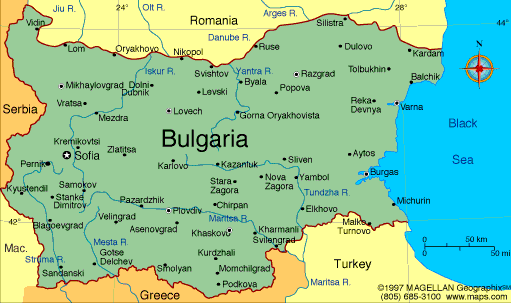
The country’s strategic position links Central and Eastern Europe with the Mediterranean and the Middle East. It shares borders with Romania to the north, Serbia and North Macedonia to the west, Greece and Turkey to the south, and the Black Sea to the east. Bulgaria's capital, Sofia, is located in the western part of the country.
Famous for its ancient history, varied geography, and colorful culture, the country features everything from mountain ranges and fertile plains to Black Sea beaches.
If you want more in-depth information about Bulgaria, check out our Bulgaria Profile!
Let’s explore more about Bulgaria’s geography, regions, and fascinating traditions!
Bulgaria Profile
History of Bulgaria
The history of Bulgaria can be traced back to the earliest settlements in modern Bulgaria, with evidence of hominid occupation dating back at least 1.4 million years. Around 5000 BC, a sophisticated civilization already existed, producing some of the first pottery, jewellery, and golden artefacts in the world.
The story begins with the Slavic invasions of the Balkan Peninsula in the 6th and 7th centuries CE. According to ancient sources, there were two Slavic tribes north of the Danube at this time, the Slavenae and the Antae. In 680 CE, the Bulgars, a Turkic-speaking people, crossed the Danube and founded the state of Bulgaria. Subsequent intermixing with the Slavs led to the establishment of the distinct Bulgarian ethnos, which was then absorbed by the Byzantine Empire in 1018, but it regained independence in 1908.Throughout the 20th century, the country underwent great and sweeping changes in both politics and society. The state became socialist in 1946 after World War II, while communism collapsed after 1989, leading to the democratic republic of Bulgaria.
Geography of Bulgaria
Bulgaria is 110,994 square kilometres (42,855 sq mi) in size and has a population of about 6,714,560 people, according to the latest 2025 statistics. It is one of Europe’s most geographically diverse countries and contains some great natural locations over such a small space - mountains, plains, rivers and coastline. It is located in Southeastern Europe, and its neighbors are Romania, Serbia, North Macedonia, Greece and Turkey. While Bulgaria's western border is defined by the Black Sea.
The Balkan Mountains (Stara Planina) are the dominating mountain range in the country, running east-west for over 550 kilometers and forming a natural barrier between northern and southern Bulgaria. To the south, the Rhodope Mountains feature forested slopes and villages steeped in folklore. To the west is the Rila Mountain, with the highest peak - Mount Musala (9,597.8 ft). The coastline of the Black Sea is more than 350 kilometers and has sandy beaches and resort towns, including Varna and Burgas. The country's most significant rivers are the Maritsa, Iskar, and Struma.
Bulgaria has a continental climate: hot summers, and cold winters with well-marked seasons between them. In summer, temperatures are mild (25–35 °C, 77–95 °F), and in winter they can even fall below 0 °C (32 °F), especially up in the mountains. Rainfall is moderate, concentrated in spring and autumn, and serious droughts are uncommon.
There are also a number of lively, vibrant, and historic cities in Bulgaria that reflect the country's cultural richness and geographical variety. Its capital is Sofia, situated at the foot of one of Bulgaria's most well-known mountains - Vitosha. It serves as the country's political and financial center. Other important cities are the cultural festivals of Plovdiv (whose Roman remains include an ancient stadium) and the major port city of Varna on the Black Sea.
Major Cities
Interesting Facts about Bulgaria
- One of Europe’s Oldest Countries: Bulgaria has been a separate country since 681 AD, ranking it among the oldest countries in Europe to have preserved its original name.
- Early History: Human activity in the region now known as Bulgaria dates back 1.6 million years. Examples of early humans include a fragment of a fossilised human skull found near Varna, as well as Neanderthal remains from the caves of Magura and Bacho Kiro, famous throughout Europe.
- The Cyrillic Alphabet: The Cyrillic system is used by over 120 languages today and was developed in what is now Bulgaria in the 9th century by Saints Cyril and Methodius.
- Home to Europe's Tallest Peak in the Balkans: At 9,597.8 feet, Mount Musala of the Rila Mountain range is the highest peak of all the Balkan Peninsula.
- UNESCO World Heritage List: Bulgaria announced that it had 10 places on the UNESCO list – including Rila Monastery, the Thracian Tomb of Kazanlak and the old town of Nessebar.
- Famous Rose Oil Production: The Bulgarian rose valley is one of the most exquisite rose oil producers in the world, widely used in luxury perfumery.
- Prolific wildlife: Home to over 600 plant species in its mountains, including the rare Bulgarian candytuft, it’s also where bears and wolves roam.
- Folk Music and Dance: Bulgaria is revered for its distinctive folk music, with its complex rhythms and harmonies, and traditional dances such as the Horo.
- Mineral Springs and Spa Culture: Bulgaria has more than 600 mineral springs, making it one of the leading destinations in Europe for balneotherapy and spa tourism.
People Also ask…
What is Bulgaria famous for?
Bulgaria is known for its history, UNESCO World Heritage sites and natural beauty. Cyrillic alphabet, Rose Valley and rose production, traditional folk music, as well as the beautiful mountains that make up the Balkan, Rila and Pirin ranges, among others trooped down by miles of coastline from the Black Sea.
What is the Landscape of Bulgaria?
Bulgaria is a geographically diverse country, including mountainous areas, plains, rivers, and a swathe of the Black Sea coast. The Rila and Belasica mountain ranges, along with others across Bulgaria, are characterized by long-lasting snow cover. The fertile Danubian and Thracian plains yield abundant crops, including grains, fruits, and renowned Bulgarian wines.
What is the Currency of Bulgaria?
The official currency of Bulgaria is the Bulgarian Lev (BGN). It is pegged to the euro at a fixed rate of 1 EUR = 1.95583 BGN, providing financial stability. Although Bulgaria is part of the European Union, it has not yet adopted the euro. Cash is common, but cards are widely accepted in cities and tourist areas.
What is the Cuisine of Bulgaria?
The cuisine of Bulgaria reflects a rich history, blending culinary tradition and geography. All three share Mediterranean and Middle Eastern influences, though the latter are more prominent. Notable dishes include Shopska salad - a refreshing mix of tomatoes, cucumbers, peppers, onions, and white cheese, banitsa - a flaky pastry filled with cheese or spinach, and kebapche - a seasoned grilled minced meat dish similar to a sausage. Yoghurt and cheese are part of the staples, while in coastal areas, you can treat yourself to tasty Black Sea seafood. Local wine or rakia often accompany these meals.
|
|
 |


