Poland Profile
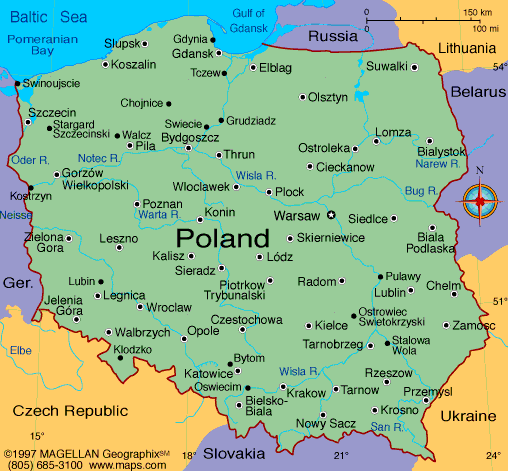
Poland is a Central European country bordered by Germany, Czechia, Slovakia, Ukraine, Belarus, Lithuania, and the Baltic Sea. Its strategic position in Europe has shaped a long and complex history. Poland is a land of diverse landscapes, spanning flat plains, dense forests, rolling hills, and mountainous southern borders, offering both cultural and natural richness.
With a strong sense of national identity, dynamic cities, and historical ties across Europe, Poland is a prominent member of the European Union and NATO, and continues to grow as a major political and economic force in the region.
History of Poland
Poland’s roots trace back over a millennium, with the formation of the first Polish state under Mieszko I in the 10th century. It became a powerful kingdom and later part of the Polish–Lithuanian Commonwealth, which was one of the largest and most populous countries in Europe during the 16th and 17th centuries.
However, between the late 1700s and World War I, Poland was partitioned by neighboring empires and disappeared from the map for over a century. After briefly regaining independence in 1918, Poland faced devastation in World War II, followed by decades under communist rule as a Soviet satellite state.
In 1989, Poland transitioned to democracy and rapidly developed its economy. Today, it is one of Europe’s emerging powers and a key regional player.
Geography of Poland
Poland covers an area of approximately 312,696 square kilometers. The terrain is mostly lowland, especially in the north and center, with lakes, rivers, and agricultural plains dominating the landscape. The Carpathian Mountains, including the Tatras, stretch along the southern border with Slovakia.
The Baltic coast in the north includes sandy beaches, cliffs, and ports such as Gdańsk. The country is traversed by major rivers including the Vistula, Oder, and Warta. Forests cover about one-third of the country, and protected areas include 23 national parks and numerous nature reserves.
Poland has a temperate climate, with cold winters and warm summers, and seasonal variations across its regions.
Facts & Figures About Poland
-
Area: 312,696 square kilometers
-
Population: Around 37.5 million
-
Capital: Warsaw
-
Borders: Germany, Czechia, Slovakia, Ukraine, Belarus, Lithuania, Russia
-
Coastline: Along the Baltic Sea
-
Official Language: Polish
-
Currency: Polish złoty (PLN)
-
EU Membership: Since 2004
-
Major Rivers: Vistula, Oder, Warta
Major Cities
-
Warsaw – Capital city, economic and political center
-
Kraków – Historic royal city and cultural hub
-
Wrocław – Known for its rivers, bridges, and architecture
-
Gdańsk – Key port on the Baltic Sea
-
Poznań – Commercial center and trade fair city
-
Lublin – Cultural center of eastern Poland
-
Katowice – Heart of the Silesian industrial region
People also ask…
What is Poland known for?
Poland is known for its rich history, medieval cities, Catholic heritage, pierogi and traditional cuisine, and resilience through centuries of invasions and political change.
Is Poland part of the Schengen Area?
Yes. Poland is part of the Schengen Area, allowing border-free travel within much of Europe.
What language is spoken in Poland?
Polish is the official and most widely spoken language. It uses the Latin alphabet and has strong Slavic roots.
|
|
 |


