Russia Profile
History of Russia
The history of Russia is a long matter of intertissuing cultures, empires, and revolutions. It has its roots among the East Slavs, who occupied the territory about the 9th century, founding Kievan Rus' with Kyiv as its capital. This early federation embraced Christianity in the year 988, and the impact on Russian culture and identity was profound. In the 13th century, the Mongol invasion devastated Kievan Rus' and led to its fragmentation into various principalities.
By the 14th century, the Grand Duchy of Moscow emerged, gradually uniting these regions and expelling the Mongols during the reign of Ivan III, known as Ivan the Great, who established the framework for the Kingdom of Russia. This was especially important during World War II when the USSR was one of the largest players in global affairs.
This was a geopolitical rivalry rooted in the Cold War era, accompanied by technological innovation. However, by the late 1980s, both internal strife and economic challenges contributed to the breakup of the Soviet Union in 1991. The Russian Federation was created. Since then, Russia has changed dramatically, negotiating the challenges of a post-Soviet society while vying for dominance on the world stage under leader Vladimir Putin.
Geography of Russia
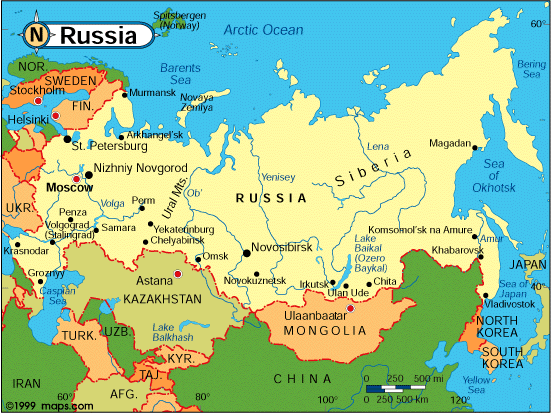
Russia is the biggest country in the world, with an overall size of over 17 million square miles and making up more than one-eighth of Earth's inhabited land area. It covers a large area of Eastern Europe and northern Asia.
As its size suggests, Russia sets land borders with many other countries. Its borders are immense, crossing 16 time zones and traversing a stunning range of landscapes and climates. Its western neighbors include Finland, Estonia, Latvia, Lithuania, Poland and Ukraine. To the south, it borders Kazakhstan, China, and several other Central Asian states, plus North Korea. To its east, Russia reaches the Pacific Ocean. It shares borders with the Arctic Ocean to the north.
The ruled territory nation has mixed terrains - from plains to tundra, mountains, and jungles. The Ural Mountains are a natural divide between Europe and Asia, and the Siberian part of the country boasts vast taiga forests and frigid weather. The world’s deepest lake, Lake Baikal is also located in the Siberian part. The third largest in the world and the longest river in Europe is the Volga River is located in Western Russia. It is one of the most important inland waterways for transport and trade.
Major Cities in Russia
- Moscow: The capital city, Moscow is a lively metropolis with a rich history, featuring landmarks like the Kremlin, and the Red Square as well as cultural institutions like the Bolshoi Theatre.
- Saint Petersburg: The city of "Holy Peter", built by Peter the Great, is famous for its beautiful architecture, canals, and rich culture. It is home to the Hermitage Museum, one of the largest and oldest museums in the world.
- Novosibirsk: The biggest city in Siberia and an important industrial and cultural center with theaters, museums, and the Trans-Siberian Railway.
- Yekaterinburg: Situated in the Ural Mountains, Yekaterinburg serves as a major industrial center and is famous for its historical significance.
- Kazan: Situated in the Republic of Tatarstan, Kazan combines Russian and Tatar influences and boasts the impressive Kazan Kremlin, a UNESCO World Heritage Site.
Interesting Facts about Russia
- Trans-Siberian Railway: The Trans-Siberian Railway is the longest railway line in the world, spanning over 5,600 miles, all the way from Moscow to Vladivostok. What is astonishing about it is that it passes through eight time zones.
- Lake Baikal: The estimated age of Baikal Lake is about 25 million years and it is believed to be the world’s deepest lake.
- Culture: Russia is known for its rich cultural heritage in literature, music, and ballet. Word-known writers such as Leo Tolstoy and Fyodor Dostoevsky have helped define global culture. Space travel: Yuri Gagarin holds the distinction of being the first man to step into space in 1961.
People also ask…
What is the climate in Russia?
Russia has diverse climatic conditions across its enormous territory, from the Arctic climate in the north to temperate climate areas in the south. Buttons of the Siberian region bring extreme cold, with winter temperatures falling below −22 °F in some regions (−30 °C). On the other hand, the southern areas have better climates to support agriculture.
What is the capital of Russia?
Moscow is Russia's capital, its largest city, and a major political, economic, and cultural center.
What are the languages people speak in Russia?
Russian is the state language of Russia and it is used by most of the population. Similarly, a few of the regional languages are spoken by several ethnic groups in the country. In addition to Russian, there are several minority languages such as Tatar, Chechen, and Bashkir.
What is the currency in Russia?
The primary currency of Russia is the Russian ruble (RUB). It is represented with ₽ and is used all over the country, for all transactions.
What is the cuisine in Russia?
Russian cuisine is famous for being filling and varied, with an emphasis on meat, potatoes, bread, and fermented foods. Popular dishes include borscht (beet soup), pelmeni (meat dumplings), and blini (thin pancakes typically served with sour cream or caviar). Traditional drinks include vodka and kvass (a fermented drink made from rye).
What is the population of Russia as of 2025?
With around 145 million people, Russia is the ninth most populated country in the world. Ethnic Russians (the largest share of the population), Tatars, Ukrainians, Bashkirs, and Chechens are among the ethnic groups that make up the country.
What are the main religions of Russia?
Most Russians are Russian Orthodox Christians, but there are large populations of Muslims, particularly in the Volga and Caucasus regions. Smaller groups practice other religions, including Judaism and Buddhism.
What type of government does Russia have?
Russia is a federal semi-presidential republic, with a strong president. The president, Vladimir Putin, is the head of state and head of government, and the prime minister, Mikhail Mishustin, runs the government.
Which are the best National Parks in Russia?
Russia has a lot of famous places and is full of history and culture. The Kremlin in Moscow is a fortified complex that is the center of Russian power, with the famous Red Square and St. Basil’s Cathedral. The Hermitage Museum in St. Petersburg is one of the world’s largest and oldest art museums, situated in a beautiful former royal residence.
Siberia’s Lake Baikal is the world’s deepest freshwater lake and a UNESCO World Heritage site. The Golden Ring is another popular tourist spot. It is a collection of historic towns northeast of Moscow, showcasing well-preserved architecture and churches from medieval Russia.
What drives the economy of Russia?
Russia's economy is partially regulated, especially when it comes to oil, natural gas, and defense. It is one of the leading energy resource producers, but its economy suffers from a lack of diversification and international sanctions.
|
|
 |
 |


