Gibraltar is a British Overseas Territory located at the southern tip of the Iberian Peninsula in Europe. It is a destination like no other, rich in history, geographical features, and cultural diversity.
Tucked on the southern edge of Europe, where the Mediterranean Sea meets the Atlantic Ocean, Gibraltar’s strategic location has defined its history. From the massive Rock of Gibraltar to its bustling town center and ocean cliffs, each area has something different to explore.
This small territory covers about 6.5 square kilometers. Despite its size, Gibraltar has a vibrant population of over 40,000 people and a fascinating mix of British and Mediterranean cultures. It’s famous for its rich history, strategic location, and breathtaking views across the Strait of Gibraltar.
Whether you’re curious about it as a piece of topography, its natural features, or its coastline wonders, Gibraltar's geography makes it one of Europe’s most enigmatic locations, combining brawn and beauty in one effortless sweep.
Ready to test your world knowledge? Dive into Infoplease’s Ultimate World Geography Quiz - a fun way to explore amazing places and landmarks of the world beyond Gibraltar.
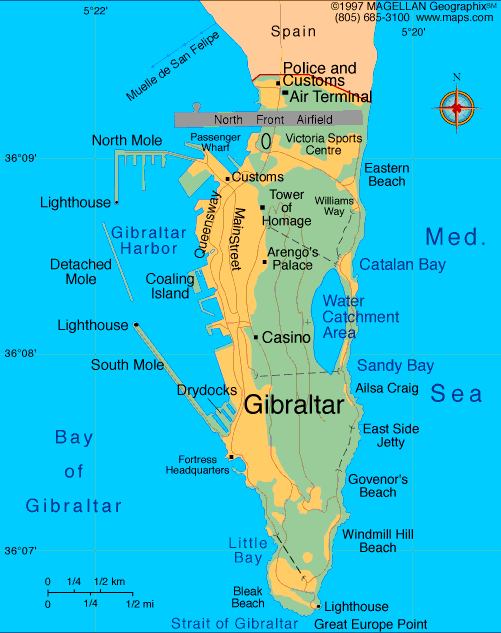
Gibraltar Profile
History of Gibraltar
The story of Gibraltar is an extraordinary tale of strategic value, multiculturalism, and hundreds of years of struggle and transformation. A small area dominated by the famous Rock of Gibraltar, this territory has been a key link between Europe and Africa for millennia.
The territory was captured by British forces during the War of the Spanish Succession in 1704. It was formally handed over to Britain in 1713 under the Treaty of Utrecht. It remained in British control for more than two centuries.
With a history spanning more than 3,000 years, Gibraltar has been associated with various cultures. It is dotted with numerous historic sites and monuments that bespeak the influence of the Phoenicians, Moors, and Romans. Evidence of early human habitation dates back to the Neanderthals, whose remains were found in Gorham’s Cave, which is now a UNESCO World Heritage site.
Today, Gibraltar is a vibrant community that blends British and Mediterranean cultures. It remains an important tourist destination, famous for its historic sites, stunning views, and unique wildlife.
Geography of Gibraltar
Gibraltar features various landscapes - cliffs, rolling hills, and a narrow coastal lowland. It occupies a strategic position at the southern end of the Iberian Peninsula. It is presided over by the distinctive Rock of Gibraltar, an impressive limestone monolith that rises to 426 meters above sea level. This natural wonder not only serves as the territory’s unofficial skyline, but it also provides a 360-degree view of the Mediterranean Sea, Atlantic Ocean, and, if you are squinting hard enough, can see the distant coast of Africa on clear days.
The territory is divided into three distinct regions: the Upper Rock Nature Reserve, its densely populated city, and its busy harbor. Gibraltar's Mediterranean climate, characterized by warm, dry summers and mild, wet winters, contributes to its status as an idyllic natural fortress and a lively place for its inhabitants and tourists.
Gibraltar has a pleasant Mediterranean climate, with hot, dry summers and mild, wetter winters. Its location between the Mediterranean Sea and the Atlantic Ocean keeps temperatures moderate year-round, offering over 300 days of sunshine annually.
Summer temperatures average around 25–30°C (77–86°F), while winters are mild, rarely falling below 12°C (54°F). Most rainfall occurs between November and March. The territory is also known for the Levante wind, a warm eastern breeze that sometimes forms the famous “levanter cloud” over the Rock.
Major Areas
- Gibraltar Town
- Ocean Village
- Catalan Bay
- Upper Town
- Europa Point
Interesting Facts about Gibraltar
- Strategic Location: Gibraltar straddles the mouth of the Mediterranean Sea, overseeing the Strait of Gibraltar, one of the world’s most vital maritime choke points.
- The Iconic Rock: The Rock of Gibraltar towers about 426 meters above sea level and defines the skyline, an epitome of strength and longevity.
- Pillars of Hercules: According to Greek legend, the Rock was one of the mythical “Pillars of Hercules” that marked the edge of the known world.
- Hidden Caves: More than 140 caves penetrate the Rock, including Gorham’s Cave, a UNESCO World Heritage site that contains evidence of Neanderthal habitation.
- Europe’s Only Wild Monkeys: Gibraltar is home to the Barbary macaque, the only wild monkey population in Europe, and a treasured local symbol.
- Unique Airport Runway: A road cuts across the runway of Gibraltar International Airport, and traffic stops when planes land or take off.
- Rich Wildlife: More than 600 plant species flourish here, among them the rare Gibraltar candytuft, not found anywhere else on mainland Europe.
- Multicultural Heritage: The people of Gibraltar are of British, Spanish, Genoese, and Maltese origin, and they speak both English and the local dialect, Llanito.
- Fortress of History: With 25 miles of tunnels inside the rock, Gibraltar has endured dozens of sieges and served as a strategic fortress in many wars.
- Ingenious Water Supply: While it has no rivers, Gibraltar has developed clever systems to collect rainwater and now depends on state-of-the-art desalination.
People also ask…
What country does Gibraltar belong to?
Gibraltar is a British Overseas Territory at the southern end of Spain. Though it shares a land border with Spain, Gibraltar's sovereignty is held by the United Kingdom under a local government system.
What is Gibraltar famous for?
Gibraltar is best known for the Rock of Gibraltar, its massive limestone cliffs, and the wild Barbary macaques, the only free-roaming monkeys in Europe. It is also famous for its historical fortifications and strategic position at the entrance of the Mediterranean Sea.
Can you visit the Rock of Gibraltar?
Yes! Visitors can tour the Rock of Gibraltar, including Gorham’s Cave, the Mediterranean Steps, and the Apes’ Den. The upper plateau affords glorious panoramic views of Gibraltar and Spain across the glittering Mediterranean as far as Morocco on clear days.
What is the Currency of Gibraltar?
The local currency in Gibraltar is the Gibraltar Pound (GIP), and it is directly linked to the pound sterling at par value. Cash is taken everywhere, while most shops, restaurants, and hotels accept credit cards.
What is Food Like in Gibraltar?
Gibraltar's fare reflects its multi-ethnic roots: British, Spanish, Mediterranean, and North African. Favourite foods are calentita (a chickpea-flour bread) and panni, a pancake-like dish made with chickpea flour and olive oil, originating in Genoa. Small plates in a tapas-style format are also standard, as are British cuisine and local wine.
|
|
 |


