Germany is a Central European country that has played a dominant role in the continent’s history and is still one of the most powerful countries. As the most populous nation in the EU, the country boasts a long history and a reputation for cultural, technological, and economic influence.
From its snow-capped Alps to its rugged countryside, Germany is well known for its scenic landscapes, but it also has urban centers that fuse modernity and tradition. There’s something for everyone — whether you’re strolling the beating streets of Berlin, sipping beer in Munich, or exploring Germany’s breathtaking Rhine Valley. So, let’s check the map, regions, geography, and some fun facts about this beautiful country.
Germany Profile
History of Germany
Germany’s history is complicated, having been molded over centuries by myriad political and cultural forces. The modern German state has its roots in the Holy Roman Empire, a federation of German-speaking lands that existed from 800 AD to 1806.
In the 19th century, the country was united under Prussian leadership, and in 1871, the German Empire was proclaimed. The unification came after the Franco-Prussian War, which established Germany as an emerging empire in Europe.
The early 20th century was rife with turmoil, notably Germany’s central participation in both world wars. The country experienced poisonous economic conditions, an agonizing suffering of the citizenry, and incredible political turbulence after its defeat in World War I which eventually produced the Nazi party and the rise of Adolf Hitler.
World War II, one of the deadliest conflicts known to man, claimed millions of lives and, in its wake, it split Germany into East and West. The Cold War then intensified that divide, as West Germany emerged as a democratic, capitalist nation and East Germany fell under Soviet communist influence. The Berlin Wall was built in 1961 and came down in 1989 when the Cold War ended. A united federal Germany was born in 1990, bringing East and West together under one democratic banner.
Since then, Germany has grown into one of the world’s leading economic powers since reunification, with particular strengths in automotive manufacturing, engineering, and innovation.
Geography of Germany
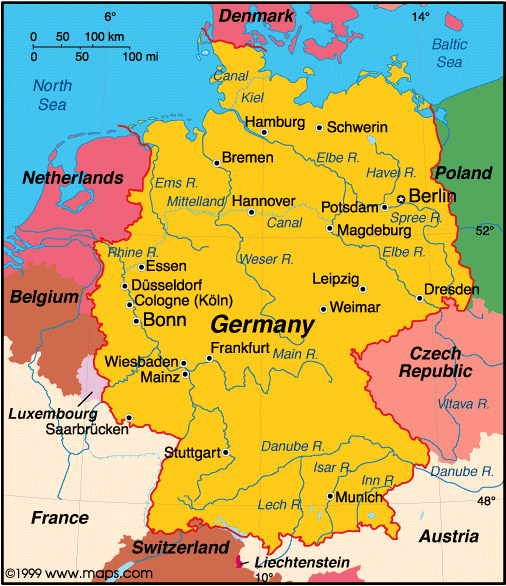
Germany's geographical location is the center of political, cultural, and trade affairs of the European continent. The country has a size of 138,070 square miles. Stretching across the middle of Europe, Germany borders Denmark to the north, Poland and the Czech Republic to the east, Austria and Switzerland to the south, and France, Luxembourg, Belgium, and the Netherlands to the west.
The landscape of Germany is varied, with great forests, mountain ranges, and rivers. In the south, the country is capped by the Alps, the highest point of which is the Zugspitze at 2,962 meters. The central area has gradual hills. The northern part of Germany is low-lying and touches the North Sea and the Baltic Sea.
There are many sizable rivers, including the Rhine, Elbe, and Danube, all of which contribute to the quality of the land and act as important transportation channels.
Major cities in Germany
- Berlin: Germany's capital and one of the country's largest cities, known for its rich history, vibrant cultural scene, and famous landmarks like the Brandenburg Gate and the Berlin Wall Memorial.
- Munich: Truly a city where traditions meet modernity and innovation. Known as the land of Bavaria for its beer gardens, Oktoberfest, and many cutting-edge tech companies.
- Hamburg: A large port city, mainly known for its naval heritage and contemporary structures.
- Frankfurt: Germany’s engine and its financial hub, home to Europe’s central bank. It serves as an economic center and offers a vibrant nightlife.
- Stuttgart: Often called “the cradle of the automotive universe”, this city is home to brands like Mercedes-Benz and Porsche - two of the most popular car brands in the world. Visitors can also visit the Mercedes and Porsche museums to explore the history of automotive innovation.
5 Fun Facts about Germany
Home of the Autobahn: Germany is known for its autobahns and highways with certain stretches that have no speed limits, meaning that you can drive as fast as you wish in certain parts.
World's First Paper Money: Germany printed the world's first paper money in the 17th century
A Country of Castles: More than 25,000 castles exist throughout Germany, many of which are internationally renowned, including Neuschwanstein Castle, which inspired Disney’s Sleeping Beauty Castle. Most of these castles are from medieval times and reside across the rolling countryside.
People also ask…
What is the population of Germany?
Germany has a population of about 84 million and is the E.U.'s most populous country. The main ethnic majority is German, but there are also large ethnic minorities of Turkish, Italian, Polish, and Russian origin. The country also has a large population of immigrants and expatriates from other countries, adding to its storied cultural diversity.
What’s the capital of Germany?
The capital city of Germany is Berlin, and it is famous for its lively arts scene and historical landmarks like the Brandenburg Gate and the Berlin Wall Memorial. Its various neighborhoods and modern skylines bring it to life as one of the most thrilling cities in all of Europe.
What languages are spoken in Germany?
The most commonly spoken language in Germany is German, and is the official language of the country. There are many dialects, including Bavarian, Saxon, and Swabian, that reflect the country’s cultural diversity. English is also very common and is spoken almost everywhere, particularly in big cities and among the youth.
What is the cuisine of Germany?
The cuisine is hearty and full of variety, with regional specialties such as sausages (Wurst), schnitzel (breaded and fried meat), and pretzels. Bavaria is known for its beer culture.
What is the public transportation like in Germany?
Germany has a very well-developed and well-operating public transport system that has trains, buses, and subways. The DB network connects major cities and towns and makes cross-country travel easy and convenient.
What drives the economy in Germany?
Germany is also Europe’s largest economy and the fourth-largest in the world. It has a very well-developed manufacturing sector, encompassing automotive, engineering and chemicals.
What are the main religions of Germany?
The most prevalent religion is Christianity, where most people are Roman Catholic or Protestant (especially in Bavaria and northern Germany). There is also a growing Muslim minority, as well as a smaller presence of Jews, Buddhists, and Hindus.
What is the German education system like?
Germany has a highly regarded education system, which is free and compulsory from ages 6 to 18. The system is divided into primary schools (Grundschule), followed by different types of secondary schools that prepare students for vocational training or university. German universities are known for their research output, and many are tuition-free for both domestic and international students.
|
|