Finland is a Northern European country situated between Sweden, Norway, and Russia, with its southern coastline along the Baltic Sea. A map of Finland reveals its vast forests, thousands of lakes, and key cities such as Helsinki, Tampere, and Oulu.
Known for its high quality of life, progressive policies, and deep connection to nature, Finland blends modern development with traditional Nordic values. The country shares a long land border with Russia and plays a key role in Arctic policy, regional diplomacy, and environmental leadership in Europe.
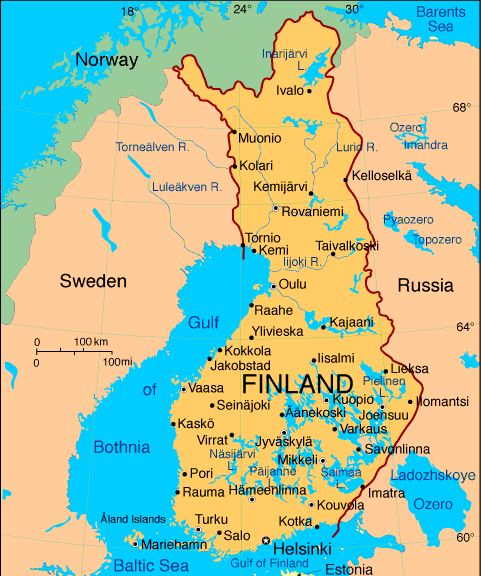
Finland Profile
History of Finland
Finland was part of the Swedish kingdom for several centuries before being ceded to the Russian Empire in 1809. It remained an autonomous Grand Duchy under Russia until declaring independence in 1917 following the Russian Revolution.
During World War II, Finland fought two wars against the Soviet Union, after which it maintained neutrality during the Cold War while preserving its independence. It officially joined the European Union in 1995 and became a member of NATO in 2023.
Modern Finland is known for its democratic institutions, universal education, and technological innovation, with a strong emphasis on sustainability and social welfare.
Geography of Finland
Finland covers approximately 338,000 square kilometers, making it one of the largest countries in Europe by area. The terrain is heavily shaped by glaciers, resulting in thousands of lakes, islands, and low-lying hills.
- Over 75% of the country is covered in forest
- It has more than 180,000 lakes
- The Archipelago Sea features thousands of small islands
- The north includes part of the Arctic Circle in the Lapland region
- Winters are long and cold, especially in the north, while summers are mild and bright
- The country has a humid continental to subarctic climate
Finland’s landscape plays a vital role in its economy, supporting industries such as forestry, paper production, and outdoor tourism.
Major Cities
- Helsinki – Capital and largest city on the southern coast
- Espoo – Part of the Greater Helsinki area, known for tech and innovation
- Tampere – Inland industrial and cultural hub
- Turku – Historical port city on the southwest coast
- Oulu – Northern city with strong tech and university presence
- Jyväskylä – Central Finnish city known for education and architecture
- Rovaniemi – Gateway to Lapland and official hometown of Santa Claus
Facts About Finland
- Finnish and Swedish are the official languages
- Euro (EUR) is the official currency
- Finland has been ranked one of the happiest countries in the world
- Sauna culture is an essential part of life
- Home to the indigenous Sámi people in the north
- Midnight sun and polar nights occur in Lapland
- The education system is considered one of the best globally
- Forestry and clean tech are core economic sectors
People Also Ask
What regions are shown on the Finland map?
The map shows Finland’s 19 regions including Uusimaa, Pirkanmaa, Lapland, North Ostrobothnia, and Southwest Finland, along with major lakes and national parks.
Is Finland part of the Arctic?
Yes. The northern part of Finland, known as Lapland, extends into the Arctic Circle, experiencing polar day and night phenomena.
What is the terrain like in Finland?
The terrain is mostly flat with rolling hills, dense forests, glacial lakes, and a jagged coastline with many islands. The far north features tundra and fells.
What is Finland known for internationally?
Finland is known for education, technological innovation, design, nature tourism, environmental policy, and social welfare systems.
|
|
 |


