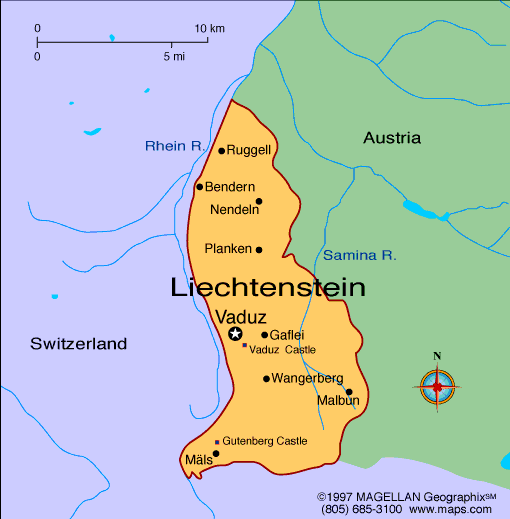
Liechtenstein is a small, landlocked country in Central Europe nestled between Switzerland and Austria. A map of Liechtenstein shows a narrow strip of land running north to south along the Rhine River, with alpine terrain covering most of its area. Despite its size, the country is known for its wealth, low taxes, and high quality of life.
Covering just 160 square kilometers, Liechtenstein is one of the smallest countries in the world. It operates as a constitutional monarchy and maintains a strong economy focused on finance, manufacturing, and tourism. Its central location and mountainous landscape make it a notable destination for both business and outdoor enthusiasts.
Liechtenstein Profile
The territory of modern Liechtenstein was once part of the Holy Roman Empire. In 1719, the Holy Roman Emperor officially recognized the region as the Principality of Liechtenstein, named after the ruling Liechtenstein family who still govern today.
The country remained largely rural until the 20th century. After World War II, Liechtenstein developed rapidly due to its strong banking sector and political neutrality. It joined the United Nations in 1990 and the European Economic Area in 1995, while maintaining independence from the European Union.
Today, Liechtenstein is a stable, prosperous nation with deep-rooted traditions and a modern economy.
Geography of Liechtenstein
Liechtenstein’s geography is dominated by the Alps in the east and the Rhine River in the west. The terrain is mountainous, with sharp peaks, forested slopes, and scenic valleys.
- The highest point is Grauspitz at 2,599 meters
- The Rhine River forms the western border with Switzerland
- The eastern side borders Austria
- The country has no coastline or airports but excellent road connectivity
- It experiences a temperate alpine climate with snowy winters and mild summers
Due to its location, Liechtenstein is ideal for hiking, skiing, and other alpine activities. The small land area is densely organized with towns, farmlands, and protected natural areas.
Major Cities
- Vaduz – The capital and political center, home to the royal family and key museums
- Schaan – The largest municipality by population and a business hub
- Balzers – Known for its historic castle and scenic views
- Triesen – Residential and cultural area south of Vaduz
- Eschen – Growing municipality with industrial importance
- Mauren – A quiet town in the north with historic sites
Facts About Liechtenstein
- It is a constitutional monarchy ruled by Prince Hans-Adam II
- Liechtenstein is double landlocked, surrounded by landlocked countries
- The official language is German
- The Swiss franc is used as the official currency
- There are no airports or seaports, travel is by road or rail
- The country has low unemployment and high GDP per capita
- Liechtenstein is a member of Schengen but not the EU
- There is no military, defense is handled through agreements with Switzerland
People Also Ask
Where is Liechtenstein located?
Liechtenstein is located in Central Europe, between Switzerland to the west and Austria to the east, in the Upper Rhine Valley.
What is the terrain of Liechtenstein like?
The country is mountainous, with rugged alpine peaks, narrow valleys, and the Rhine River forming its natural border.
Is Liechtenstein a monarchy?
Yes. It is a constitutional monarchy with an active royal family. The Prince of Liechtenstein holds significant executive power.
What is Liechtenstein known for?
Liechtenstein is known for its strong economy, banking sector, low taxes, high standard of living, and beautiful alpine scenery.
|
|
 |


