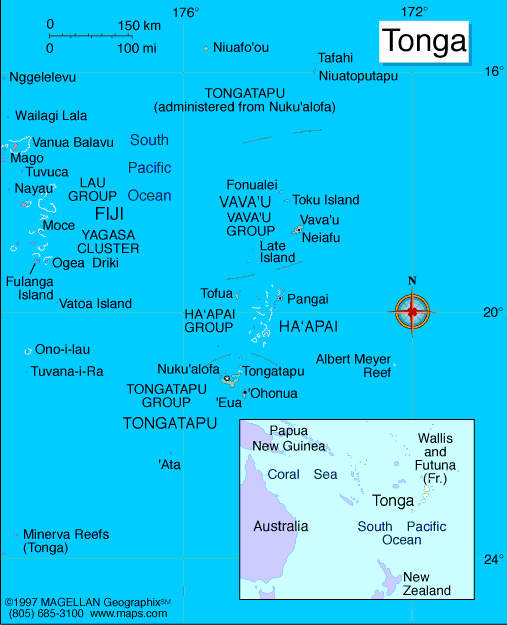
Tonga is a Polynesian kingdom in the South Pacific made up of over 170 islands, of which around 36 are inhabited. A map of Tonga shows a scattered chain of islands stretching over 800 kilometers, organized into four main island groups: Tongatapu, Ha'apai, Vava'u, and the Niuas. Known as the "Friendly Islands," Tonga has preserved much of its traditional culture while also participating in regional and international affairs.
With a population of around 100,000, the Kingdom of Tonga is the only remaining monarchy in the Pacific. Its capital, Nuku'alofa, sits on the largest island, Tongatapu. The islands offer a mix of volcanic landscapes, coral reefs, and lagoons, making the nation both geologically interesting and naturally beautiful.
Tonga Profile
History of Tonga
Tonga's history stretches back over 3,000 years. The earliest settlers were Austronesian-speaking Polynesians who developed complex societies across the islands. By the 12th century, Tonga had become a regional power under the Tu'i Tonga Empire, extending its influence across parts of Polynesia.
European contact began in the 17th century, most notably with Dutch explorers and later British captain James Cook, who gave Tonga its nickname. Unlike many neighboring islands, Tonga was never colonized. Instead, it negotiated treaties and maintained its independence. It became a constitutional monarchy in 1875 and a fully independent member of the Commonwealth in 1970.
Geography of Tonga
Tonga consists of both low-lying coral islands and higher volcanic islands. The islands are split into several groups:
- Tongatapu Group – Southernmost and home to the capital
- Ha'apai Group – Central region with flat coral atolls and volcanic islands
- Vava'u Group – Northern islands known for deep harbors and tourism
- Niuas – Remote northern islands with traditional communities
Tonga sits on the Pacific Ring of Fire, so volcanic activity is common. The country experiences a tropical climate, with a wet season from November to April and a drier season from May to October.
Major Islands and Centers
- Nuku'alofa – Capital and main port city on Tongatapu
- Neiafu – Tourism and sailing hub in Vava'u
- Pangai – Administrative center of the Ha'apai group
- Eua – Known for forests and hiking trails, southeast of Tongatapu
- Niuafo'ou – Volcanic island in the far north
Facts About Tonga
- Tonga is the only Pacific nation never colonized by a foreign power
- The country is a constitutional monarchy with a reigning king
- The majority of the population follows Christianity
- Whale-watching is popular, especially in Vava'u
- The Tongan calendar still follows traditional lunar phases for some events
- Rugby is the national sport and a source of pride
- The local language is Tongan, but English is widely used
- The archipelago is prone to cyclones and volcanic activity
People Also Ask
Where is Tonga located on the map?
Tonga is in the South Pacific Ocean, east of Fiji, south of Samoa, and northeast of New Zealand. It lies roughly between latitudes 15 and 23 degrees south.
Is Tonga a part of Polynesia?
Yes. Tonga is part of Polynesia and is one of the major Polynesian island nations, along with Samoa, Tuvalu, and the Cook Islands.
What is Tonga known for?
Tonga is known for its monarchy, unbroken independence, traditional culture, and as a destination for whale watching and ocean adventures.
What languages are spoken in Tonga?
The official languages are Tongan and English. Most Tongans are bilingual, especially in education and government contexts.
|
|
 |


