Known for its breathtaking landscapes and cultural richness, Papua New Guinea occupies the eastern half of the island of New Guinea in the southwestern Pacific. This remarkable country is a place where dense rainforests, towering mountains, and pristine coastlines meet a mosaic of indigenous cultures.
From the vibrant capital, Port Moresby, to remote Highland villages, Papua New Guinea offers a unique blend of natural beauty and cultural diversity. Home to nearly 11 million people as of 2025, Papua New Guinea is one of the most culturally and linguistically diverse nations in the world. Its landscapes are equally varied - from volcanic peaks, lush valleys, winding rivers, to coral-strewn shores that create a stunning backdrop for exploration.
If you want to learn more fascinating facts, dive into our detailed overview.
Papua New Guinea Profile
History of Papua New Guinea
Papua New Guinea has a rich and complex history shaped by its geography, cultural diversity, and colonial encounters. Archaeological evidence shows that the island of New Guinea has been inhabited for tens of thousands of years, making it one of the earliest centers of human settlement outside Africa. Indigenous communities developed complex societies, with unique languages, traditions, and trade networks, long before outside contact.
European exploration began in the 16th century, when Portuguese and Spanish navigators first sighted the island. In the 19th century, both Germany and Britain claimed parts of the territory, while the southern portion eventually became an Australian-administered territory. Missionaries, traders, and colonial administrators brought new technologies, religions, and governance systems, leaving a lasting impact on local societies.
During World War II, the territory was a major battleground in the Pacific, with fierce fighting between Japanese and Allied forces, particularly in the Kokoda Track campaign. The war left deep scars but also strengthened national consciousness and regional ties. Papua New Guinea gained independence from Australia on September 16, 1975, becoming a sovereign nation while maintaining membership in the Commonwealth.
Today, the country is home to nearly 11 million people, representing over 800 distinct languages and a vast array of cultures, making it one of the most culturally diverse countries in the world. Despite modern challenges, the country continues to preserve its rich traditions while engaging with global development and environmental conservation.
Geography of Papua New Guinea
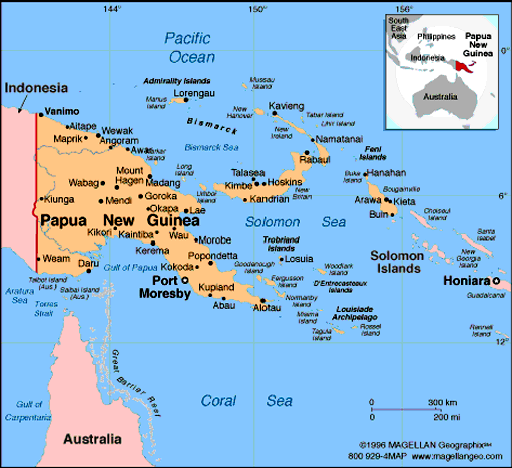
Papua New Guinea is a land of striking contrasts, stretching across the eastern half of New Guinea, which is the world’s second-largest island, and spilling over to hundreds of smaller islands, including New Britain, New Ireland, and the Bismarck Archipelago. It covers roughly 462,840 square kilometers (178,700 square miles).
To the west, the land shares a border with Indonesia, while the rest of the nation is surrounded by the waters of the Bismarck Sea, Solomon Sea, Coral Sea, and Pacific Ocean, giving it some of the most diverse marine landscapes in the Pacific. Inland, the country’s topography is famously rugged: the Central Cordillera slices through the island with jagged peaks reaching over 4,500 meters (14,764 feet), cloaked in mist and tropical forests. Between these mountains lie fertile valleys and sprawling river systems, like the Sepik and Fly, which carve winding paths across the land. Coastal plains and lowland rainforests provide another layer of natural beauty, while volcanic activity has left a patchwork of fertile soils and dramatic landscapes.
The climate mirrors this variety. Most of the country is tropically warm and humid, but the highlands enjoy cooler temperatures and crisp evenings. Rainfall is heavy from November to March, sometimes accompanied by cyclones, while the drier months from May to October offer perfect conditions for exploration.
Major Cities
- Port Moresby
- Lae
- Mount Hagen
- Goroka
- Madang
- Kokopo
- Kimbe
- Alotau
- Wewak
- Vanimo
Interesting Facts About Papua New Guinea
- Land of a Thousand Languages: Papua New Guinea is home to over 800 living languages, more than any other country in the world.
- Hidden Villages: Many remote communities had little to no contact with the outside world until the 20th century.
- Rainforest Kingdom: The country contains one of the world’s largest remaining tropical rainforests, rich in biodiversity.
- Volcanic Land: Papua New Guinea has numerous active volcanoes, particularly on New Britain and the surrounding islands.
- Bird Paradise: Some of the world’s rarest birds, including spectacular birds-of-paradise, are native to the country.
- Historic Battleground: The Kokoda Track was a critical site during World War II, symbolizing courage and resilience.
- Last Frontier: Papua New Guinea was one of the last regions of the world to be fully explored by outsiders.
People also ask…
What is Papua New Guinea famous for?
Papua New Guinea is famous for its incredible cultural diversity, with over 800 languages and thousands of distinct ethnic groups. It’s also known for its lush rainforests, volcanic mountains, vibrant coral reefs, and unique wildlife, including birds-of-paradise.
What is the cuisine of Papua New Guinea like?
Papua New Guinean cuisine is largely based on root crops like taro, sweet potatoes, and yam, as well as fresh seafood, tropical fruits, and vegetables. Traditional dishes often feature mumu, a method of cooking meat and vegetables in an earth oven using hot stones.
What languages are spoken in Papua New Guinea?
While Tok Pisin, English, and Hiri Motu are the official languages, the country is home to over 800 indigenous languages, making it the most linguistically diverse country in the world.
What are the main tourist attractions in Papua New Guinea?
Popular attractions include the Kokoda Track, the vibrant Highlands cultural shows, the coral reefs of Madang and Kavieng, active volcanoes like Tavurvur, and ecotourism in the dense rainforests of the Sepik and Central Highlands.
|
|
 |


