As the largest state in the United States, Alaska is known for its natural beauty, cultural history, and geographical diversity. With its unrivaled wilderness, stunning mountains, and thriving wildlife, Alaska is a mix of past and present. This article explores the history, geography, major cities, and interesting facts about this unique state.
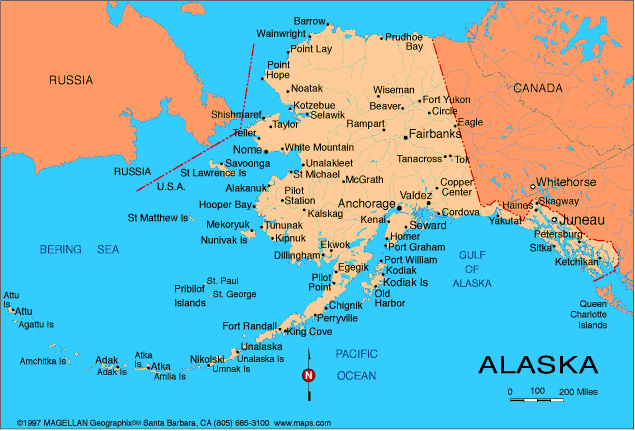
Alaska Profile
History of Alaska
Alaska's history has been shaped by the influence of its native people, European exploration, and the expansion of the United States. Various Native Alaskan groups, including the Inupiat, Yupik, Aleut, and Tlingit people, are most notable. They have inhabited the region for thousands of years. These communities have established vibrant cultures and ways of life, intimately connected to the land and the ocean.
In the 18th century, Russian explorers arrived, seeking fur and other resources. The fur trade boomed, and Russian settlements sprang up. However, by the middle of the 19th century, the Russian Empire found it increasingly hard to maintain its territories in North America. The United States bought Alaska from Russia in 1867 for $7.2 million - a bargain commonly called “Seward’s Folly” after Secretary of State William H. Seward, who arranged the purchase.
Alaska was designated as a U.S. territory in 1912 and became the 49th U.S. state on January 3, 1959. Economic growth and migration shaped Alaska’s contemporary identity, which was driven by the discovery of gold, oil, and other natural resources.
Geography of Alaska
Alaska covers approximately 663,300 square miles, making it larger than the next three largest states (Texas, California, and Montana) combined.
Alaska is located in the far northwest of North America and is bordered by Canada to the east and the Arctic and Pacific Oceans to the north and south, respectively. The state has a maritime boundary with Russia to the west. Alaska is known for its rugged terrain and diverse ecosystems, which include mountains, forests, tundra, and coastal regions.
Major Cities in Alaska
Alaska is widely known for its wilderness, but the state is also home to several cities essential to the culture and economy:
- Anchorage: Home to about 40 percent of the state's population, Anchorage is Alaska's largest city. Deemed as a transportation and logistics hub, the city has thriving arts, shopping, and dining scenes.
- Fairbanks: Situated in the interior of the state, Fairbanks experiences large temperature fluctuations and is a jumping-off point for visiting the Arctic. It is also the home of the University of Alaska Fairbanks.
- Juneau: The state capital Juneau is only reached by boat or plane. The city, flanked by mountains and the sea, is famous for its historic sites and its proximity to breathtaking natural scenery.
- Sitka: This former capital of Russian Alaska is steeped in history and culture, with the best of Native Alaskan and Russian influences on display.
- Ketchikan: A fishing port known as the “Salmon Capital of the World,” Ketchikan is also the home of several totem pole parks.
Facts & Figures
- Alaska has the longest coastline of any U.S. state: With over 6,640 miles of coastline and 33,000 miles of shoreline - more than the rest of the U.S. states combined.
- You can see the Northern Lights in Alaska: Alaska is one of the best places in the world to see the aurora borealis (Northern Lights), especially during the winter months, when the skies are darkest and clearest.
- Alaska has the largest national park in North America: Wrangell-St. Elias National Park & Preserve stretches over 13 million acres and is the largest national park in the U.S. - larger than each of the nine smallest U.S. states!
People also ask…
What is Alaska known for?
Alaska has towering mountains, glaciers, and scenic wilderness. It is known for its wildlife as well as the Northern Lights. Alaska also has a unique cultural history involving historic Russian influence and native Alaskan tribes.
What is the capital of Alaska?
Juneau is the capital of Alaska. It is unique in that it can only be accessed by boat or plane — there are no roads connecting it to the rest of the state. Juneau is famous for its mountains, picturesque views, and historic past.
What is the weather like in Alaska?
Temperatures across Alaska vary widely, depending on the area. For example, winter in the inland areas is cold and can reach -40°C, whereas coastal locations experience milder winters. The north, particularly the Arctic, can be brutally cold, with winter temperatures consistently plummeting below 28°C.
What is the state flower of Alaska?
Alaska's state flower is the Alpine Forget-Me-Not (Myosotis Alpestris). It was selected for its fragile beauty and capacity to flower in the harsh, freezing Alaskan weather. It represents remembrance and is sometimes seen growing in the fields of the state’s wildflowers.
When is the best time to visit Alaska?
The best time of year to visit Alaska is from May until September, when temperatures are warmer and wildlife becomes lively. It's also a great time to do anything that takes you outdoors, such as mountain climbing, fishing, and sightseeing. For those who wish to take in the Northern Lights spectacle during winter months, September through April is best.
What is the biggest city in Alaska?
Anchorage, the largest city in Alaska, has around 40% of the state's population. This town is both a trade and resource center. In addition to having nearly all the modern amenities available in town, it offers city sophistication. With the mountains and ocean nearby, there is lots to do around to keep nature enthusiasts constantly engaged - hiking, fishing, skiing, wildlife watching, and much more
What type of wildlife is in Alaska?
Alaska is home to a diverse fauna including grizzly bears and moose, caribou and wolves. It boasts over 500 species of birds. There are salmon runs and rainwater reservoirs, too, while humpback whales and sea otters swim in the rock-bound seas.
How long is the summer day in Alaska?
The summer days are extremely long in Alaska, especially towards the far north. In cities like Barrow (Utqiaġvik), the sun never sets at all for the whole summer, creating the phenomenon called “the midnight sun”. In the south, the sun goes down around 11 PM in June, but it doesn’t get dark until late in the evening.
Why is Alaska referred to as “Seward’s Folly”?
Alaska used to be known as “Seward’s Folly,” named after Secretary of State William H. Seward, who negotiated the purchase of Alaska from Russia in 1867 for 7.2 million dollars. To many Americans at the time, buying Alaska was a waste of money — until gold, oil, and other riches were discovered there, and the purchase proved to be a wise one.
What is the tallest mountain in Alaska?
Alaska's highest point is Mount Denali (formerly Mount McKinley), which is 20,310 feet high (6,190 meters). It is also the highest peak in North America, it attracts climbers from around the globe.
Does Alaska have earthquakes?
Yes, earthquakes often occur in Alaska because it lies along the Ring of Fire, where tectonic plates meet. It is one of the planet’s most seismically active regions. Indeed, Alaska experienced the strongest earthquake ever recorded in North America: the Great Alaska Earthquake of 1964, with a magnitude of 9.2.
What are some popular activities in Alaska?
Alaska offers many popular activities like hiking, fishing, wildlife viewing, and cruising tours along coastlines. More adventurous visitors can also go dog sledding, glacier trekking, and even ice climbing. History buffs will want to explore Alaska’s national parks and museum exhibits for insights into the state’s rich culture and history.
|
|
 |


