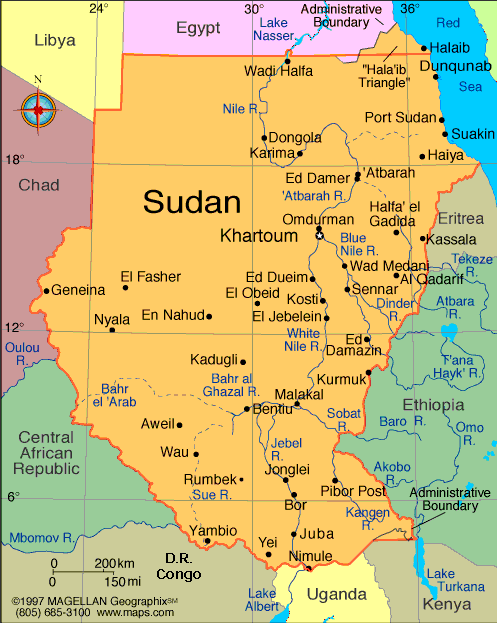
Sudan is a country located in Northeastern Africa, bordered by South Sudan, Egypt, Libya, Chad, Central African Republic, Eritrea, Ethiopia, and the Red Sea. The capital city is Khartoum, situated at the confluence of the White Nile and Blue Nile rivers. Sudan is among the largest countries in Africa and has a population of over 51 million people, making it a diverse nation with dozens of ethnic and linguistic groups. The official language is Arabic, but other languages spoken include Beja, Fur, Nubian, Masalit, and more, so let’s explore this fascinating country.
If you want to discover more in-depth information on Sudan as a country, check out our Sudan Profile!
Plus, test your country knowledge with our world geography quiz, Can You Name These African Landmarks?
Sudan Facts: History
Sudan, also known as the Republic of the Sudan, has a fascinating history that dates back to the Nubian civilization of ancient times. Over the years, Sudan has been ruled by various empires, including the Egyptian, Assyrian, and Roman empires. In the 1800s, Sudan became a part of the Ottoman Empire, and in the early 1900s, it was colonized by the British. Sudan gained independence in 1956, but the country has faced political instability and conflict, including the Darfur conflict, which began in 2003.
Sudan has undergone many political and social changes in recent years. In 2019, a popular uprising ousted longtime president Omar al-Bashir after three decades in power. A transitional government was established to lead the country to democracy. But the shift has been fraught, with economic woes, army interference in politics, and simmering insurgencies in Darfur, Blue Nile, and South Kordofan. There has been another military coup in Sudan in 2021 that has further destabilized the country politically. Despite these struggles, the Sudanese people continue to strive for peace, stability, and a future built on unity and democratic governance.
Sudan Facts: Geography
Sudan is the third-largest country on the map of Africa, covering an area of 1,886,068 square kilometers. The country is divided into 18 administrative divisions, including Khartoum, Gedaref, Gezira, Kassala, Sennar, and White Nile. The Nile River runs through the country, and there are many other rivers, including the Blue Nile and the White Nile. The country is also home to the Red Sea, which is a popular tourist destination.
According to the political map of Sudan, it is divided into 18 administrative divisions, including Khartoum, Gedaref, Gezira, Kassala, Sennar, and White Nile. Each division is further divided into localities (mudiriyat) and then villages (tazkiyat). The capital city, Khartoum, is its own administrative division and is further divided into 7 localities. The other 17 divisions are each divided into a varying number of localities and villages. The divisions are primarily based on geography and tribal affiliations.
Major Cities of Sudan
Sudan and the Middle East
Sudan is a part of the African continent, but it also has close ties with the Middle East. Omdurman, a city located near Khartoum, is the largest city in Sudan and is considered to be the Islamic capital of the country. The Republic of Sudan has been a member of the Arab League since 1956.
It is situated on the Red Sea, which serves as a trade route between Africa and the Arabian Peninsula. The country has strong economic and political relations with some of the Arab states in the Persian Gulf, especially Saudi Arabia, the United Arab Emirates, and Qatar (with which it shares substantial trade ties), but also invests heavily in Middle Eastern financial centers such as Beirut, Lebanon, via its sovereign wealth fund. These connections underscore Sudan’s position as a hinge between Africa and the Arab world.
Southern Sudan
South Sudan became an independent country in 2011 after a long civil war with the government of Sudan. The country is located to the south of Sudan and is bordered by Sudan to the north, Ethiopia to the east, Kenya to the southeast, Uganda to the south, the Democratic Republic of the Congo to the southwest, and the Central African Republic to the west. Check out the South Sudan country map for more information!
Sudan Facts: Tourist Attractions
Sudan has many tourist attractions, including ancient pyramids, historic mosques, and natural wonders. Here are some of the top Sudanese attractions:
- Port Sudan: This is a city located on the Red Sea coast and is a popular destination for beachgoers and scuba divers. The city is known for its beautiful beaches and coral reefs.
- Juba: The capital city of South Sudan, Juba is located on the White Nile River. The city has many historic sites, including the Juba Bridge and the Juba Cathedral.
- Abyei: The Abyei Area is a contested region between Sudan and South Sudan, but it is also a popular tourist destination. The area is home to many Nubian villages, and visitors can experience Nubian culture and traditions.
- Nyala: This metropolis is the capital city of South Darfur and is known for its beautiful landscapes and wildlife. Visitors can go on safari and see animals such as giraffes, gazelles, and zebras.
- Khartoum: Khartoum is the capital city of Sudan and is located at the confluence of the White Nile and Blue Nile rivers. The city has many historic sites, including the Presidential Palace, the National Museum of Sudan, and the Khartoum Grand Mosque.
- Other Major Cities: Apart from its capital city, Sudan has other major cities, including Dongola, El Obeid, and Geneina.
- Red Sea Diving: Coral reefs off Port Sudan make up one of the most biodiverse marine ecosystems in the world, home to colorful fish, dolphins, and even dugongs.
- Desert Fun: The Bayuda Desert provides camel trekking, as well as exploration of the old volcanic rocks.
- Cultural Markets: Home to Africa’s biggest traditional market, Souq Omdurman (Khartoum) is the place for spices, crafts and local food.
People Also Ask...
If you're inspecting the Sudan map, you may have some queries about the region. Here are some of the most frequently asked questions, along with their answers.
Is Sudan an Arab or African Country?
Sudan is a country located in Northeastern Africa and is considered both an Arab and African country due to its diverse cultural and ethnic heritage. The official language of Sudan is Arabic, and its currency is the Sudanese pound.
What Was Sudan Called Before?
Sudan was known as Nubia and Kush in ancient times. Later, it was ruled by various empires, including the Egyptian, Assyrian, and Roman empires. In the 1800s, it became a part of the Ottoman Empire, and in the early 1900s, it was colonized by the British. Sudan gained independence in 1956.
Why Did Sudan Split Into Two Countries?
Sudan split into two countries, Sudan and South Sudan, in 2011 after decades of civil war. The conflict was largely based on religious and ethnic differences between the Muslim north and the Christian and animist south. The split was intended to end the violence and create two separate nations.
What is the Capital of Sudan?
Sudan’s capital is Khartoum. It constitutes, along with Omdurman and Khartoum North, Sudan’s largest urban area. It is the country’s centre of administration and education.
What Language Is Spoken in Sudan?
The Official Language is Arabic. English is also acknowledged, especially in education and business. Dozens of native languages are also spoken, including Nubian, Beja, Fur, and Masalit, attesting to the country’s ethnic diversity.
What is the main religion in Sudan?
Most people in Sudan are Muslim. There are also strong Christian and small traditional religious communities, particularly in areas contiguous with South Sudan.
What is Sudan Famous For?
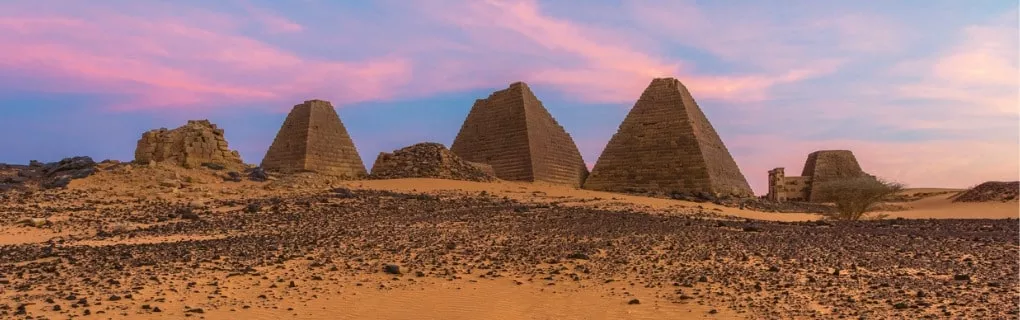
Sudan is well-known for its pyramids of Meroë as well as its Nubian culture. On the Red Sea coast, there are excellent diving sites. In addition, its geography is strikingly varied - from deserts in the north to savannahs and mountains to the east and west, as well as fertile lands on either bank of the Nile.
What is the Currency of Sudan?
The currency in Sudan is the Sudanese Pound (SDG). It has undergone some inflation, similar to many African currencies in recent years, but it is considered the official tool for exchange.
What is the Cuisine in Sudan?
Sudanese dishes include kisra (a fermented sorghum flatbread), ful medames, okra stews, different vegetables, and meats such as lamb or chicken. Karkadeh (an infusion of hibiscus flowers) and coffee spiced with ginger and cinnamon are common beverages.
What is the Population of Sudan?
Sudan's population is approximately 51 million people according to recent statistics (2025). It’s one of Africa’s most populous countries. It is considered a young country, with more than 60 percent of Sudanese being under the age of 25.
Does Sudan Have Tourist Attractions?
Yes, Sudan has many attractions, such as the ancient pyramids of Meroë, the National Museum of Sudan in Khartoum, and the coral reefs of Port Sudan on the Red Sea. Visitors also explore Nubian villages, traditional markets, and historical mosques.
What Type of Government does Sudan Have?
Sudan is, in theory, a federal republic. However, its government has gone through cycles of military and civilian rule. Since 2019, the country has been in a transitional phase, with numerous political challenges.
What are Some of the Natural Resources in Sudan?
Sudan is endowed with oil, gold, copper, and rich farmland. The economy is largely based on agriculture and mining. The exports of gold, in particular, have become significant in recent times.
Is Sudan Safe to Visit in 2025?
The safety of travel in Sudan varies by area. Places such as Khartoum and the Red Sea coast are relatively safe, drawing more adventurous travelers, while Darfur and other war-torn areas are considered dangerous. Travelers should review updated advisories before visiting.
What Are Some Traditions in Sudan?
Hospitality is an important part of the Sudanese culture, and guests may be greeted with local tea, coffee, and food. Music and dance are important, ranging from Nubian folk songs to Sufi spiritual ceremonies. Traditional clothing is the men’s jalabiya and for women, a colorful toob.
|
|
 |


