Senegal Profile
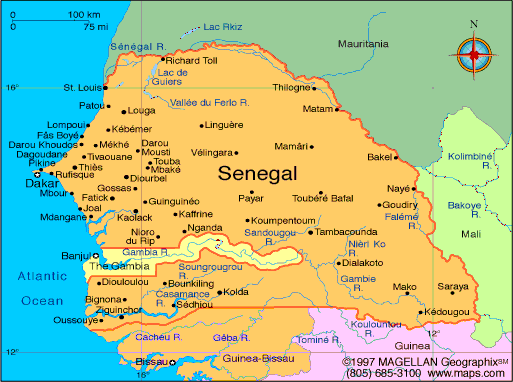
Senegal is a country located on the westernmost edge of Africa, bordered by Mauritania, Mali, Guinea, Guinea Bissau, and the Atlantic Ocean. A map of Senegal shows a nation shaped by rivers, coastal plains, and savanna landscapes, with strong historical and cultural ties across West Africa. The Gambia forms a narrow enclave extending into Senegal along the Gambia River.
Known for its political stability and cultural influence, Senegal plays a central role in the region. Dakar, the capital, is a major Atlantic port and one of West Africa’s most important cities.
History of Senegal
Senegal’s history includes powerful precolonial kingdoms such as Tekrur, Jolof, and Cayor. These states were active in trade across the Sahara and along the Atlantic coast. Islam spread through the region centuries ago and remains central to Senegalese society.
France established colonial control in the 19th century, and Senegal became one of the most important territories in French West Africa. The country gained independence in 1960 under its first president, Léopold Sédar Senghor. Since independence, Senegal has maintained relative political stability and a tradition of democratic governance.
Geography of Senegal
Senegal covers approximately 196,700 square kilometers and features mostly flat to gently rolling terrain. The country lies within the Sahel zone, transitioning from semi arid conditions in the north to more tropical landscapes in the south.
Key geographic features include:
-
Atlantic Coast: Sandy beaches and major fishing areas
-
Senegal River: Forms part of the northern border with Mauritania
-
Gambia River: Runs east to west through the center of the country
-
Casamance Region: Lush southern area with forests and rivers
-
Sahel Zone: Dry grasslands in northern Senegal
The climate is tropical, with a distinct dry season and a rainy season from June to October.
Major Cities
-
Dakar – Capital and largest city, political and economic center
-
Thiès – Major transportation and industrial hub
-
Saint Louis – Historic city near the Mauritanian border
-
Kaolack – Important commercial and agricultural center
-
Ziguinchor – Largest city in the Casamance region
-
Touba – Religious center and site of the Great Mosque
Facts & Figures About Senegal
-
Area: 196,700 square kilometers
-
Population: Around 18 million
-
Capital: Dakar
-
Official Language: French
-
Other Languages: Wolof, Pulaar, Serer, Diola
-
Currency: West African CFA franc (XOF)
-
Independence: 1960 from France
-
Religion: Predominantly Muslim
-
Main Industries: Agriculture, fishing, mining, services
People also ask
Where is Senegal located?
Senegal is located in West Africa, bordered by the Atlantic Ocean, Mauritania, Mali, Guinea, and Guinea Bissau.
What is Senegal known for?
Senegal is known for its music, art, religious traditions, coastal cities, and political stability.
What language is spoken in Senegal?
French is the official language. Wolof is the most widely spoken language in daily life.
Is Senegal safe to visit?
Senegal is generally considered one of the safer countries in West Africa, with well developed tourism infrastructure and a stable political environment.
|
|
 |


