Kenya Profile
Located in East Africa along the Indian Ocean, Kenya is a land of breathtaking landscapes, rich wildlife, and vibrant culture. From the bustling capital of Nairobi to the vast savannas of the Maasai Mara and the snow-capped peaks of Mount Kenya, the country offers a remarkable mix of natural beauty and modern life.
Home to over 58 million people as of 2026, Kenya’s geography ranges from coastal beaches and fertile highlands to arid deserts and rolling plains. Its diverse ecosystems make it a top destination for wildlife enthusiasts, while its long history and cultural heritage reflect centuries of indigenous traditions, colonial influence, and modern development.
With a thriving economy, unique traditions, and world-renowned national parks, Kenya remains one of Africa’s most dynamic and iconic nations.
For more details about Kenya’s history, geography, and culture, you can check the full overview on Infoplease.
History of Kenya
Kenya’s history is rich and diverse, shaped by centuries of migration, trade, and cultural exchange. The region has been inhabited for millions of years, with some of the oldest human fossils ever discovered found in the Great Rift Valley, making it a key site in understanding human evolution.
Over the centuries, various Bantu, Nilotic, and Cushitic peoples settled across the region, establishing communities and trade networks. By the first millennium CE, Arab and Persian traders were interacting with the coastal towns, introducing Islam and connecting Kenya to the broader Indian Ocean trade network.
In the late 19th century, Kenya became part of the British East Africa Protectorate, leading to significant changes in land ownership, infrastructure, and governance. Resistance to colonial rule grew, culminating in the famous Mau Mau Uprising (1952–1960), which played a key role in the country’s path to independence.
The country finally gained independence from Britain in 1963, with Jomo Kenyatta becoming the nation’s first president. Since then, Kenya has developed into one of East Africa’s most influential countries, balancing rapid modernization with its rich cultural and natural heritage.
Geography of Kenya
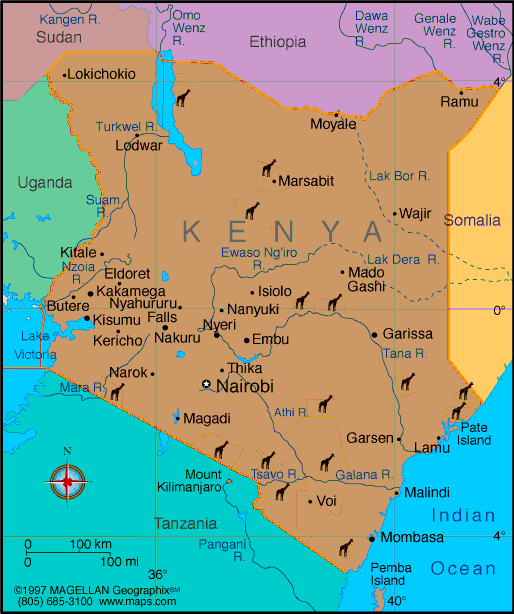
Kenya is located in East Africa, bordered by Ethiopia to the north, Somalia to the east, Tanzania to the south, Uganda to the west, and South Sudan to the northwest, with the Indian Ocean along its southeast coast. Its central position gives it a diverse and striking geography.
The country is famous for the Great Rift Valley, which splits Kenya from north to south, creating dramatic escarpments, volcanic hills, and fertile highlands. To the west lie lakes like Lake Victoria and Lake Turkana, while the east and south feature savannas, plains, and semi-arid regions. The coastline along the Indian Ocean has sandy beaches, coral reefs, and tropical forests.
The climate varies with elevation and region: the highlands enjoy mild temperatures and ample rainfall, the lowlands are hotter and drier, and the coast has a humid, tropical climate. This variety supports diverse ecosystems, from mountain forests and grasslands to savannas and desert-like areas, making Kenya one of Africa’s most ecologically rich countries.
Major cities
Facts About Kenya
-
Land of wildlife: Kenya is famous for its safaris, with the Maasai Mara and Amboseli national parks home to lions, elephants, giraffes, and other wildlife.
-
Great Rift Valley: This dramatic geological feature runs through the country, creating lakes, escarpments, and fertile highlands.
-
Birthplace of humankind: Some of the oldest human fossils have been found in Kenya’s Great Rift Valley.
-
Diverse landscapes: From snow-capped Mount Kenya to arid savannas and tropical coastal beaches, the country has an incredible variety.
-
Running champions: Kenya is renowned for producing world-class long-distance runners who dominate international athletics.
-
Cultural diversity: Over 40 ethnic groups, including the Maasai, Kikuyu, and Luo, contribute to Kenya’s rich cultural heritage.
-
Indian Ocean coast: Kenya has beautiful sandy beaches, coral reefs, and historic port towns like Mombasa.
-
Tea and coffee: Kenya is a leading producer of high-quality tea and coffee, especially in the central highlands.
-
Film locations: Kenya’s landscapes have been featured in numerous films and documentaries showcasing Africa’s wildlife.
People also ask…
What is traditional Kenyan cuisine?
Kenyan cuisine features hearty, flavorful dishes. Popular foods include ugali (cornmeal porridge), sukuma wiki (collard greens), grilled meats, fresh fish, and stews. Coastal regions often enjoy coconut-based dishes and spicy flavors influenced by the Indian Ocean trade.
What languages are spoken in Kenya?
The official languages are English and Swahili, but the country is home to over 40 ethnic groups, each with its own local language. Swahili is widely used for communication across communities.
What are Kenya’s top attractions?
Kenya is famous for national parks and reserves, including the Maasai Mara, Amboseli, and Tsavo. Other attractions include Mount Kenya, Lake Naivasha, Lamu Island, and the beautiful Indian Ocean coastline.
|
|
 |


