Chad Profile
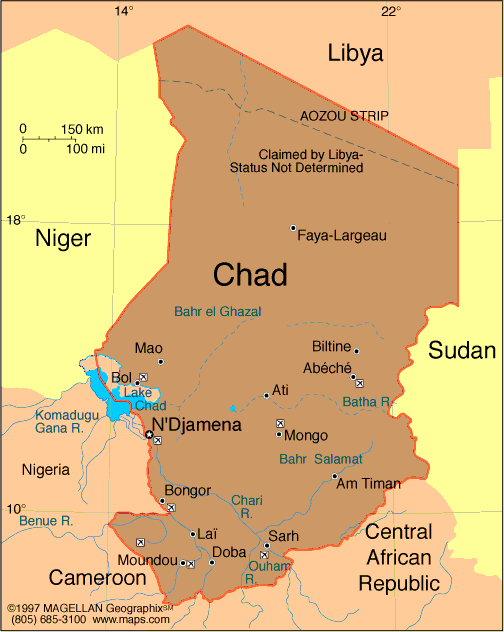
Chad is a large, landlocked country in north-central Africa, bordered by Libya, Sudan, the Central African Republic, Cameroon, Nigeria, and Niger. Its vast territory covers parts of the Sahara Desert in the north, the Sahel belt in the center, and more fertile savanna regions in the south.
Named after Lake Chad, the country is known for its environmental diversity, strategic location, and complex history. Despite economic challenges, Chad remains an important cultural and geographic crossroad between North and Sub-Saharan Africa.
History of Chad
Human settlement in what is now Chad dates back thousands of years, with rock paintings in the Tibesti Mountains and evidence of ancient civilizations around Lake Chad. Over time, the region was home to powerful kingdoms such as Kanem-Bornu, Bagirmi, and Wadai, which engaged in trans-Saharan trade and Islamic scholarship.
Chad became a French colony in the early 20th century and gained independence in 1960. Since then, it has experienced periods of instability, including civil wars and political transitions. However, recent decades have seen efforts toward greater unity and development, with a focus on improving infrastructure and governance.
Geography of Chad
Chad covers more than 1.28 million square kilometers, making it the fifth-largest country in Africa. Its geography is divided into three zones:
-
Northern Chad: Dominated by the Sahara Desert and mountain ranges like the Tibesti, this area is arid with sparse population.
-
Central Chad: The Sahelian belt features dry grasslands and supports nomadic herding and millet farming.
-
Southern Chad: A more fertile region with savannas, rivers, and agriculture, this is where most of the population is concentrated.
Lake Chad, once one of Africa’s largest lakes, has significantly shrunk over the years due to climate change and water usage, but remains a vital water source.
Facts & Figures About Chad
-
Area: Approximately 1,284,000 square kilometers
-
Population: Around 17 million
-
Capital: N'Djamena
-
Borders: Libya, Sudan, Central African Republic, Cameroon, Nigeria, Niger
-
Languages: French and Arabic (official), plus over 120 local languages
-
Currency: Central African CFA franc (XAF)
-
Climate: Desert in the north, semi-arid in the center, tropical in the south
-
Natural Resources: Oil, gold, uranium, livestock, cotton
Major Cities
-
N'Djamena – Capital city at the confluence of the Chari and Logone Rivers
-
Moundou – Industrial center and hub for cotton processing
-
Sarh – Located in the fertile south, known for agriculture
-
Abéché – Key city in eastern Chad with historic significance
-
Am Timan – Regional capital of Salamat, near Zakouma National Park
People also ask…
What is Chad best known for?
Chad is known for its vast deserts, ethnic diversity, Lake Chad, and being a cultural bridge between North and Sub-Saharan Africa.
What languages are spoken in Chad?
French and Arabic are the official languages. However, dozens of indigenous languages are spoken across different regions.
Is Chad a safe country to visit?
Security varies widely by region. While some southern areas are relatively stable, the north and border areas may pose risks. Travelers should check government advisories.
|
|
 |


