Geography
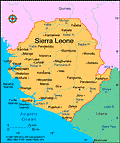
Sierra Leone, on the Atlantic Ocean in West Africa, is half the size of Illinois. Guinea, in the north and east, and Liberia, in the south, are its neighbors. Mangrove swamps lie along the coast, with wooded hills and a plateau in the interior. The eastern region is mountainous.
Government
Constitutional democracy.
History
The Bulom people were thought to have been the earliest inhabitants of Sierra Leone, followed by the Mende and Temne peoples in the 15th century and thereafter the Fulani. The Portuguese were the first Europeans to explore the land and gave Sierra Leone its name, which means “lion mountains.” Freetown, on the coast, was ceded to English settlers in 1787 as a home for blacks discharged from the British armed forces and also for runaway slaves who had found asylum in London. In 1808 the coastal area became a British colony, and in 1896 a British protectorate was proclaimed over the hinterland.
Sierra Leone became an independent nation on April 27, 1961. A military coup overthrew the civilian government in 1967, which was in turn replaced by civilian rule a year later. The country declared itself a republic on April 19, 1971.
A coup attempt early in 1971 led to then prime minister Siaka Stevens calling in troops from neighboring Guinea's army, which remained for two years. Stevens turned the government into a one-party state under the aegis of the All People's Congress Party in April 1978. In 1992 rebel soldiers overthrew Stevens's successor, Joseph Momoh, calling for a return to a multiparty system. In 1996, another military coup ousted the country's military leader and president. Nevertheless, a multiparty presidential election proceeded in 1996, and People's Party candidate Ahmad Tejan Kabbah won with 59.4% of the vote, becoming Sierra Leone's first democratically elected president.
A Decade-Long Civil War
But a violent military coup ousted President Kabbah's civilian government in May 1997. The leader of the coup, Lieut. Col. Johnny Paul Koroma, assumed the title Head of the Armed Forces Revolutionary Council (AFRC). Koroma began a reign of terror, destroying the economy and murdering enemies. The Commonwealth of Nations demanded the reinstatement of Kabbah, and ECOMOG, the Nigerian-led peacekeeping force, intervened. On March 10, 1998, after ten months in exile, Kabbah resumed his rule over Sierra Leone. The ousted junta and other rebel forces continued to wage attacks, many of which included the torture, rape, and brutal maimings of thousands of civilians, including countless children; amputation by machete was the horrific signature of the rebels. In addition to political power, the rebels, who were supported by Liberia's president Charles Taylor, sought control of Sierra Leone's rich diamond fields.
In Jan. 1999, rebels and Liberian mercenaries stormed the capital, demanding the release of the imprisoned Revolutionary United Front (RUF) leader, Foday Sankoh. ECOMOG regained control of Freetown, but President Kabbah later released Sankoh so he could participate in peace negotiations. Pressured by Nigeria and the U.S., among other countries, Kabbah agreed to an untenable power-sharing agreement in July 1999, which made Sankoh vice president of the country—and in charge of the diamond mines. The accord dissolved in May 2000 after the RUF abducted about 500 UN peacekeepers and attacked Freetown. Sankoh was captured and died in government custody in 2003, while awaiting trial for war crimes.
The conflict was officially declared over in Jan. 2002. An estimated 50,000 people were killed in the decade-long civil war. The UN installed its largest peacekeeping force in the country (17,000 troops). President Kabbah was reelected with 70% of the vote in May 2002. In 2004, the disarmament of 70,000 soldiers was completed, and a UN-sponsored war crimes tribunal opened. For the past several years, the UN has listed Sierra Leone as the world's “least livable” country, based on its poverty and the poor quality of life endured by its citizens.
International Court Convicts Charles Taylor; Democratic Elections Resume
The trial of Charles Taylor, the former Liberian president, on charges of crimes against humanity began at a UN criminal court at The Hague in 2007. He was charged with abetting the violent rebel group in Sierra Leone's civil war that was responsible for atrocities, which included hacking off the limbs of civilians, sexual slavery, conscripting child soldiers, and even cannibalism. In April 2012, after deliberating for more than a year, the court, comprised of three judges from Ireland, Samoa, and Uganda, convicted Taylor of crimes against humanity and war crimes for his support of the rebels. His conviction is the first by an international court since the Nuremberg trials.
In June 2007, three former rebel leaders were convicted of crimes against humanity by a UN-backed court. Alex Tamba Brima, Brima Bazzy Kamara, and Santigie Borbor Kanumurder were found guilty of rape and enlisting child soldiers. It was the first time an international tribunal ruled on the recruitment of children under age 15 as soldiers.
In September 2007 elections, the governing party suffered a surprising defeat when opposition leader Ernest Koroma, of the All People's Congress (APC), defeated Vice President Solomon E. Berewa, of the Sierra Leone People's Party (SLPP), 55% to 45%. The elections were Sierra Leone's first since the United Nations peacekeeping force left the county in 2004. Koroma was reelected in November 2012 to a second and final term. It was the first election held without UN supervision, and the results were deemed fair.
The UN Security Council lifted the last sanctions on Sierra Leone in September 2010, having determined that the government had gained control over the country from the rebels and that the rebels had been disarmed and had been integrated into the national army.
In April 2012, after deliberating for more than a year, the war crimes court at the Hague convicted former Liberian president Charles Taylor of aiding and abetting war crimes and crimes against humanity in Sierra Leone's civil war. His conviction was the first by an international court since the Nuremberg trials. He was sentenced to 50 years in prison.
Ebola Outbreak Kills Hundreds
An outbreak of Ebola hit Sierra Leone in March 2014. By early December, it is estimated to have killed about 1,660 people in Sierra Leone, and there were about 7,635 suspected and confirmed cases of it in the country, according to the Centers for Disease Control. It is the worst outbreak since the virus was first identified almost 40 years ago. In order to contain the virus, Sierra Leone instituted a 3-day lockdown on the country and an army police, soldiers, and about 30,000 volunteers went door to door looking for victims.
See also Encyclopedia: Sierra Leone .
U.S. State Dept. Country Notes: Sierra Leone