Geography
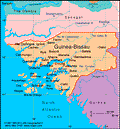
A neighbor of Senegal and Guinea in West Africa, on the Atlantic coast, Guinea-Bissau is about half the size of South Carolina. The country is a low-lying coastal region of swamps, rain forests, and mangrove-covered wetlands, with about 25 islands off the coast. The Bijagos archipelago extends 30 mi (48 km) out to sea.
Government
Republic.
History
The land now known as Guinea-Bissau was once the kingdom of Gabú, which was part of the larger Mali empire. After 1546 Gabú became more autonomous, and at least portions of the kingdom existed until 1867. The first European to encounter Guinea-Bissau was the Portuguese explorer Nuño Tristão in 1446; colonists in the Cape Verde islands obtained trading rights in the territory, and it became a center of the Portuguese slave trade. In 1879, the connection with the islands was broken.
The African Party for the Independence of Guinea-Bissau and Cape Verde (another Portuguese colony) was founded in 1956, and guerrilla warfare by nationalists grew increasingly effective. By 1974 the rebels controlled most of the countryside, where they formed a government that was soon recognized by scores of countries. The military coup in Portugal in April 1974 brightened the prospects for freedom, and in August the Lisbon government signed an agreement granting independence to the province. The new republic took the name Guinea-Bissau.
Guinea-Bissau Experiences a Series of Coups
In Nov. 1980, João Bernardo Vieira headed a military coup that deposed Luis Cabral, president since 1974. In his 19 years of rule, Vieira was criticized for crony capitalism and corruption and for failing to alleviate the poverty of Guinea-Bissau, one of the world's poorest countries. Vieira also brought in troops from Senegal and the Republic of Guinea to help fight against an insurgency movement, a highly unpopular act. In May 1999 rebels deposed Vieira.
Following a period of military rule, Kumba Yalá, a former teacher and popular leader of Guinea-Bissau's independence movement, was elected president in 2000. In Sept. 2003 he was deposed in a military coup. Yalá's increasingly repressive measures and refusal to hold elections were cited as causes. In 2005, former president Vieira returned from six years of exile in Portugal and won the presidency in the July 2005 elections.
Prime Minister Aristides Gomes resigned in April 2007, after Parliament voted to censure his government. Martinho Ndafa Kabi was appointed as his successor. President Vieira dissolved Parliament in August 2008, precipitating the fall of the government of Prime Minister Kabi. Former prime minister Carlos Gomes Júnior succeeded Kabi.
A Presidential Assassination, A Death, and A Coup
President Vieira was shot to death by army troops in March 2009. The assassination was said to be in retaliation for an earlier bomb attack that killed the army chief of staff, Gen. Batista Tagme Na Wai, which troops blamed on the president. The military denied a coup attempt.
In June presidential elections, former acting president Malam Bacai Sanha took 39.6% of the vote, former president Kumba Iala 29.4%, former interim president Henrique Rosa 24%, and Iaya Djalo 3.1%. Sanha prevailed over Iala in the July run-off election, winning 63% of the vote.
In Jan. 2012, Sanha died unexpectedly, leaving Guinea-Bissau leaderless. Acting president Raimundo Pereira and acting prime minister Adiato Diallo Nandigna were removed in a coup on April 12. A transition president, who may rule up to 2 years, was announced on April 20: Manuel Serifo Nhamadjo, who came in third place in the first round of the presidential election in March. He named Rui Duarte de Barros to be transitional prime minister. The National Transition Council, which will oversee the transition, will be headed by Braima Sori Djalo. Six weeks after the coup, the military junta returned power to the civilian government.
José Mário Vaz Wins Presidential Election
José Mário Vaz took office on June 23, 2014, after securing enough votes—61.9% to Nuno Gomes Nabiam's 38.1%—during the second round of presidential voting on May 18. Domingos Simos Pereira, the leader of the African Party for the Independence of Guinea-Bissau and Cape Verde (PAIGC) was named prime minister. The U.S. State Department offered these words, "These elections offer the opportunity for comprehensive reforms to break Guinea-Bissau's cycle of corruption, and make progress on providing public services and advancing the country's development."
In August 2015, President Vaz dismissed the government, including Prime Minister Pereira. Vaz appointed former Minister of National Defense Baciro Djá as the new prime minister on August 20. However, Djá's appointment was contested by his own political party, PAIGC. His appointment also raised concerns from the Economic Community of West African States, a 15-member collective, about the president being able to substitute the role of prime minister. The following month, the Supreme Court ruled that Djá's appointment was unconstitutional. He resigned on Sept. 9.
See also Encyclopedia: Guinea-Bissau .
U.S. State Dept. Country Notes: Guinea-Bissau