Updated June 5, 2025 |
Infoplease Staff

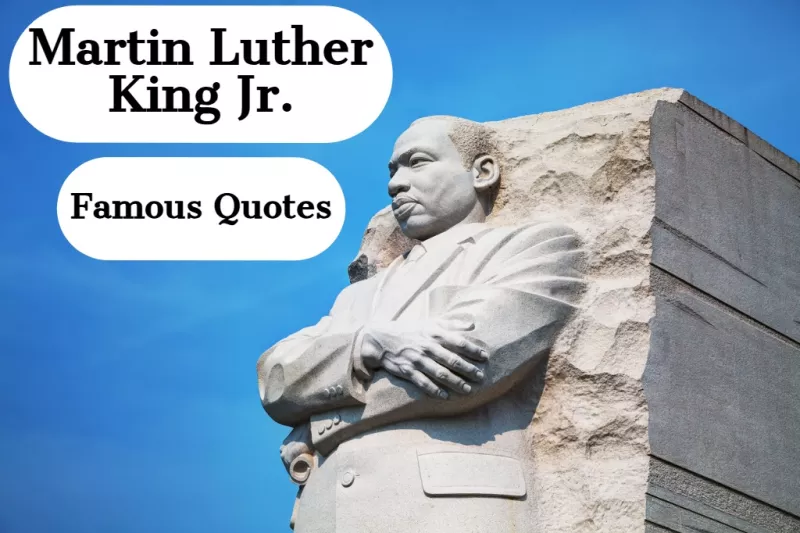
Martin Luther King has been one of the most impactful and empowering civil rights activists in history and has made some of the most important changes, whilst giving some of the most inspirational speeches. This collection features 35 Martin Luther King quotes that you’ve probably heard of, but we’re diving in a little deeper, showing you why they were said, which can help you to relive history.
Martin Luther King’s speeches left powerful words in the hearts of many, and today these words still echo on, so join us whilst we explore deeper into these quotes. Whether you're here to reflect on history or you just need some uplifting, these quotes by Martin Luther King will be sure to inspire.
The Most Powerful Martin Luther King Quotes
- “I have a dream.”
Delivered during the March on Washington, August 28, 1963.
King’s most famous line from his speech envisioning racial equality and harmony.
- “Injustice anywhere is a threat to justice everywhere.”
Letter from Birmingham Jail, April 16, 1963.
Written while imprisoned for protesting segregation in Alabama, emphasizing interconnected justice.
- “The arc of the moral universe is long, but it bends toward justice.”
Frequently quoted by King, notably in a 1967 sermon.
Attributed originally to Theodore Parker; King used it to express hope in long-term progress.
- “Faith is taking the first step even when you don't see the whole staircase.”
Quoted in speeches and sermons.
Describes the importance of acting with conviction even amid uncertainty.
- “Darkness cannot drive out darkness; only light can do that. Hate cannot drive out hate; only love can do that.”
From his book Strength to Love (1963).
A theological argument for responding to hate with love.
- “Our lives begin to end the day we become silent about things that matter.”
Often quoted from speeches in the mid-1960s.
Encourages moral courage in the face of injustice.
- “The time is always right to do what is right.”
Speech at Oberlin College, 1964.
A call to act ethically, without delay.
- “We must learn to live together as brothers or perish together as fools.”
Speech in St. Louis, 1964.
A warning about the consequences of division and intolerance.
- “Life’s most persistent and urgent question is, ‘What are you doing for others?’”
Quoted in speeches, notably at Montgomery, Alabama, 1957.
Centers service to others as a moral imperative.
- “True peace is not merely the absence of tension; it is the presence of justice.”
Letter from Birmingham Jail, 1963.
Challenges passive definitions of peace, tying it to fairness.
- “A riot is the language of the unheard.”
Press conference and speeches in 1967.
Explaining the causes of civil unrest without endorsing violence.
- “Freedom is never voluntarily given by the oppressor; it must be demanded by the oppressed.”
Letter from Birmingham Jail, 1963.
A rationale for civil disobedience.
- “I have decided to stick with love. Hate is too great a burden to bear.”
From Where Do We Go from Here: Chaos or Community? (1967).
Declares love as a strategic and moral choice.
- “The ultimate tragedy is not the oppression and cruelty by the bad people but the silence over that by the good people.”
Speech in Selma, Alabama, 1965.
Critique of passivity and indifference among allies.
- “Violence as a way of achieving racial justice is both impractical and immoral.”
From “The Trumpet of Conscience,” 1967.
Affirms nonviolence as both effective and ethical.
- “We are not makers of history. We are made by history.”
Speech at the University of Kansas, 1968.
Emphasizes the influence of historical context on present actions.
- “Change does not roll in on the wheels of inevitability, but comes through continuous struggle.”
Letter from Birmingham Jail, 1963.
Calls for sustained activism.
- “The moral arc of the universe bends at the elbow of justice.”
Variation spoken at various sermons; attributed to King adapting Parker.
Reinforces belief in the eventual triumph of justice.
- “Love is the only force capable of transforming an enemy into a friend.”
From his book Strength to Love (1963).
Encourages reconciliation over retaliation.
- “Shallow understanding from people of good will is more frustrating than absolute misunderstanding from people of ill will.”
Letter from Birmingham Jail, 1963.
Criticism of passive allies who delay justice.
- “Nonviolence is a powerful and just weapon.”
Speech upon receiving the Nobel Peace Prize, 1964.
Advocates for nonviolence as morally superior and effective.
- “He who passively accepts evil is as much involved in it as he who helps to perpetrate it.”
From various speeches, including sermons.
Asserts that silence enables wrongdoing.
- “A genuine leader is not a searcher for consensus but a molder of consensus.”
Speech in Atlanta, 1967.
Encourages leadership that shapes opinion, not follows it.
- “The function of education is to teach one to think intensively and to think critically. Intelligence plus character—that is the goal of true education.”
Morehouse College student newspaper, 1947.
Early reflection on education’s purpose.
- “If a man hasn’t discovered something that he will die for, he isn’t fit to live.”
Speech in Detroit, 1963.
Underscores the importance of conviction.
- “I am not interested in power for power’s sake, but I’m interested in power that is moral, that is right and that is good.”
From “The Quest for Peace and Justice,” Nobel Lecture, 1964.
Redefines power through a moral lens.
- “Let us not seek to satisfy our thirst for freedom by drinking from the cup of bitterness and hatred.”
I Have a Dream speech, 1963.
Urges peaceful pursuit of justice.
- “I may not get there with you. But I want you to know tonight, that we, as a people, will get to the Promised Land.”
Final speech, Memphis, April 3, 1968.
Prophetic tone on the eve of his assassination.
- “There comes a time when one must take a position that is neither safe, nor politic, nor popular, but he must take it because conscience tells him it is right.”
Speech at Riverside Church, 1967.
Defended his opposition to the Vietnam War.
- “Everything that we see is a shadow cast by that which we do not see.”
From “The Measure of a Man,” 1959.
Philosophical reflection on the unseen forces shaping society.
- “Wars are poor chisels for carving out peaceful tomorrows.”
From “Beyond Vietnam” speech, 1967.
Critique of militarism and foreign policy.
- “To be a Christian without prayer is no more possible than to be alive without breathing.”
From a sermon on spiritual life.
Highlights the importance of prayer.
- “The surest way to be happy is to seek happiness for others.”
Spoken in various sermons and interviews.
Reflects his Christian ethics of service.
- “We must accept finite disappointment, but never lose infinite hope.”
Used frequently in speeches and writings.
Encourages perseverance in the face of hardship.
- “I still believe that standing up for the truth of God is the greatest thing in the world.”
From a sermon at Ebenezer Baptist Church.
Affirms faith-based commitment to justice.


