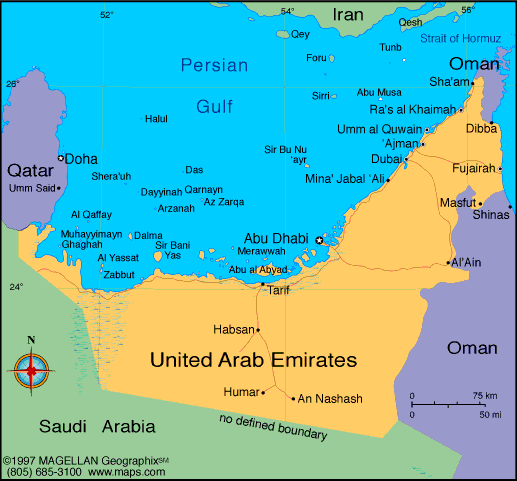
The United Arab Emirates is a federation of seven emirates on the southeastern edge of the Arabian Peninsula. It borders Saudi Arabia and Oman and has coastlines along both the Persian Gulf and Gulf of Oman. A current map of the United Arab Emirates highlights key cities like Abu Dhabi and Dubai, desert interiors, mountain ranges in the east, and extensive coastal development.
As of 2025, the UAE has over 10 million residents, the majority of whom are foreign workers. Its economy is driven by sectors including tourism, real estate, logistics, and energy.
United Arab Emirates Profile
History of the UAE
Before unification, the region was made up of independent sheikhdoms known as the Trucial States under British protection. Pearl diving, fishing, and coastal trade were the dominant economic activities for centuries.
In 1971, six emirates formed the United Arab Emirates. Ras Al Khaimah joined in 1972. Oil revenue transformed the economy, and the country rapidly developed modern infrastructure while expanding into tourism, aviation, and finance.
Geography of the UAE
The UAE spans about 83,600 square kilometers and consists mainly of desert terrain with sand dunes, gravel plains, and coastal lowlands. The eastern part features the Hajar Mountains, while the western region is flat and arid.
- The interior is mostly desert
- Mountains run through Fujairah and Ras Al Khaimah
- The coastline includes natural beaches and artificial islands
- The climate is hot, dry, and sunny year-round
Major Cities
- Abu Dhabi – Capital and political center
- Dubai – Business and tourism hub
- Sharjah – Known for culture and education
- Ajman – Small coastal emirate
- Fujairah – Port city on the Gulf of Oman
- Ras Al Khaimah – Mountainous and historic
- Umm Al Quwain – Least populated, with nature reserves
Facts About the United Arab Emirates
- The UAE is made up of seven emirates
- Abu Dhabi holds the largest oil reserves
- Dubai is home to the tallest building in the world
- Arabic is the official language; English is widely used
- The UAE dirham (AED) is the national currency
- Over 85% of the population are expatriates
- Islam is the state religion
- The country is considered one of the safest in the region
People Also Ask
What are the seven emirates of the UAE?
Abu Dhabi, Dubai, Sharjah, Ajman, Fujairah, Ras Al Khaimah, and Umm Al Quwain. You can view all seven on the UAE map.
What does the map of the UAE show?
It shows each emirate’s location, city centers, highways, coastlines, mountain regions, and reclaimed islands.
Is the UAE safe to visit in 2025?
Yes. The UAE is one of the safest countries in the region, with low crime rates and well-developed infrastructure for visitors.
What is the terrain like in the UAE?
The terrain includes desert interiors, mountain ranges in the east, and urbanized coastal zones with ports and tourist areas.
|
|
 |


