Syria, located in the heart of the Middle East, is a land of rich history, diverse landscapes, and cultural heritage that dates back thousands of years. Known for its ancient cities, archaeological treasures, and strategic location at the crossroads of Asia, Africa, and Europe, Syria has played a pivotal role in human civilization. With a population of over 25 million people, the country offers a mix of bustling urban centers, fertile plains, rugged mountains, and vast deserts.
The capital, Damascus, is one of the world's oldest continuously inhabited cities, serving as Syria’s political, cultural, and economic hub. Beyond its cities, Syria’s natural beauty, from the Mediterranean coastline and fertile Euphrates Valley to the scenic mountains and deserts, reflects the country’s geographic and cultural diversity.
This guide covers Syria’s history, geography, major cities, regions, and top attractions, offering a comprehensive look at a nation with a rich past and enduring cultural significance. For even more in-depth information, explore our Syria Overview.
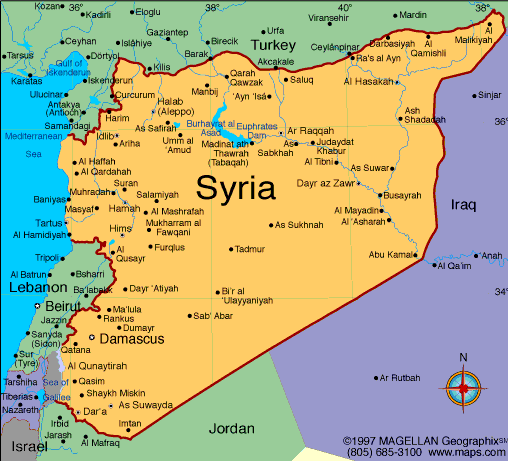
Syria Profile
History of Syria
Syria has one of the world’s oldest continuous histories, dating back thousands of years to ancient civilizations like the Sumerians, Akkadians, and Eblaites. Its strategic location at the crossroads of Asia, Africa, and Europe made it a center for trade, culture, and conquest. The cities of Damascus and Aleppo are among the world's oldest continuously inhabited cities, with rich legacies of architecture, commerce, and learning.
Throughout history, the nation was ruled by a succession of empires, including the Egyptians, Hittites, Assyrians, Persians, Greeks under Alexander the Great, Romans, and Byzantines. In the 7th century, the region became part of the Islamic Caliphates, shaping its religious, cultural, and linguistic identity. Later, it fell under Ottoman rule for centuries, leaving a lasting influence on its administrative and cultural systems.
Following World War I and the collapse of the Ottoman Empire, Syria came under French mandate before gaining independence in 1946. The modern era has been marked by political upheavals, conflicts, and social changes, yet Syria’s historical and cultural heritage, including ancient ruins, medieval citadels, and vibrant cities, remains a testament to its enduring significance in world history.
Geography of Syria
Syria is a country in the Middle East, strategically located at the crossroads of Asia, Africa, and Europe. It is bordered by Turkey to the north, Iraq to the east, Jordan to the south, Israel to the southwest, and the Mediterranean Sea to the west, giving it both inland and coastal landscapes. Covering about 185,000 square kilometers (71,500 square miles), Syria features a diverse terrain that includes fertile plains, river valleys, mountains, deserts, and a narrow Mediterranean coastline.
The western region is dominated by the coastal mountain ranges and fertile Mediterranean plains, while the Euphrates River flows from Turkey through eastern Syria, supporting agriculture in the arid interior. The Syrian Desert, which stretches across the southeast, features vast sand and rocky plains, in contrast to the country’s mountainous and riverine regions.
Syria has a Mediterranean climate along the coast, with mild, wet winters and hot, dry summers, while the interior experiences a semi-arid to arid climate, with hotter summers, cooler winters, and limited rainfall. This diversity in geography and climate has historically shaped settlement patterns, agriculture, trade routes, and cultural development.
Major Cities
Interesting Facts about Syria
- Cradle of Civilization: Syria is home to some of the world’s oldest cities, including Damascus and Aleppo, which have been continuously inhabited for thousands of years.
- Ancient Ruins: The country hosts remarkable archaeological sites like Palmyra and Ebla, reflecting its rich historical legacy.
- Cultural Heritage: Syria has been influenced by multiple civilizations, including Assyrians, Romans, Byzantines, and Ottomans, creating a rich blend of architecture and traditions.
- Religious Significance: It is home to important historical religious sites for Islam, Christianity, and Judaism
- Ancient Trade Hub: Syria’s location at the crossroads of Asia, Africa, and Europe made it a major center for trade and culture throughout history.
- Unique Cuisine: Syrian food is famous for dishes like kibbeh, hummus, falafel, and baklava, reflecting a blend of Middle Eastern flavors.
- UNESCO Sites: Syria has several UNESCO World Heritage sites, including the Ancient City of Bosra and Crac des Chevaliers.
- Traditional Crafts: Syria is known for textiles, pottery, and handwoven rugs.
People also ask…
What is Syria Famous for?
Syria is known for its ancient cities, archaeological sites, diverse landscapes, and its historic role as a crossroads of early civilizations. Cities like Damascus and Aleppo are among the world's oldest continuously inhabited cities.
What is Traditional Syrian Cuisine?
Traditional Syrian cuisine features dishes such as kibbeh, hummus, tabouli, falafel, shawarma, and baklava, often using fresh herbs, olive oil, grains, and aromatic spices. Meals are typically shared and enjoyed family-style.
What is the Climate in Syria?
Syria has a Mediterranean climate along the coast, with mild, rainy winters and hot summers, while the interior and eastern regions experience arid and semi-arid desert climates with higher temperatures and lower rainfall.
What is the Official Language of Syria?
The official language is Arabic, but other languages such as Kurdish, Armenian, and Aramaic are spoken in different regions and communities.
|
|
 |


