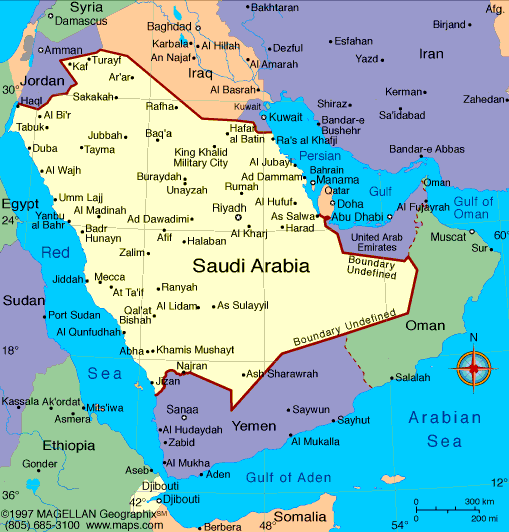
The Kingdom of Saudi Arabia, nestled in the heart of the Middle East on the Arabian Peninsula, is a country rich in history and culture. Bordered by Iraq, Jordan, Kuwait, Oman, Qatar, the United Arab Emirates, and Yemen, Saudi Arabia serves as a central hub for the region. Its significant role in Islam, with sacred cities such as Mecca (Makkah) and Medina (Madinah), further cements its importance globally.
The capital city, Riyadh, along with major cities like Jeddah and Dammam, contribute to the diverse cultural landscape of the kingdom. The country's official language is Arabic, although English is widely spoken in business and educational sectors.
If you want to discover more in-depth information on Saudi Arabia as a country, check out our Saudi Arabia Profile!
Plus, test your country knowledge with our Middle Eastern geography quiz on Saudi Arabia Map!
History of Saudi Arabia
Saudi Arabia's roots extend deep into ancient times, with civilizations like the Nabateans and the Lihyanites leaving their mark on the region. The birth of Islam in the 7th century in Mecca, where Prophet Muhammad was born, united the Arabian tribes under a single religious banner.
The Arabian Peninsula has been home to human settlements for thousands of years, with ancient civilisations such as the Thamud and Nabateans. The area gained fame for its trade routes, particularly the incense trade, which generated substantial wealth.
The Kingdom played a significant role in regional conflicts during the 1980s and 1990s, including the Gulf War in 1990-1991, when Saudi Arabia, in partnership with a coalition of countries, joined efforts to remove Iraqi forces from Kuwait.
The Al Saud family established the first Saudi state in the 18th century, which Abdulaziz Ibn Saud further expanded and consolidated in the early 20th century. Saudi Arabia's vast oil reserves have since made it a key player in regional and global politics.
Most recently, Saudi Arabia has carried out significant social and economic transformations under the leadership of King Salman and Crown Prince Mohammed bin Salman (MBS) through the Vision 2030 plan. The plan is aimed at decreasing the nation's dependence on oil, upgrading infrastructure, expanding the tourism sector and enhancing women's rights and opportunities.
Despite being situated thousands of miles from Europe, Saudi Arabia shares a connection in the form of cultural exchanges, trade, and even geographical proximity. Earth's intricate web of landscapes and cultures only serves to emphasize our interconnectedness!
Geography of Saudi Arabia
As the largest country in the Middle East, Saudi Arabia spans approximately 2.15 million square kilometers. Its geography is primarily characterized by desert landscapes and gorgeous views.
The largest stretch of sand desert in the world, the Rub' al Khali (also known as the Empty Quarter), is situated in Southeastern Saudi Arabia. It spans approximately 250,000 square miles (650,000 square kilometres) within a geological basin.
The Asir Mountains and various wadis, dry riverbeds that fill with water during rainfall, add to the country's diverse terrain. The Red Sea to the west and the Arabian Gulf (also known as the Persian Gulf) to the east outline Saudi Arabia's coastline.
Located in the southwestern part of the nation, near the Yemeni border, these mountains The Asir Mountains feature Saudi Arabia's highest summit, Jabal Sawda, which rises to an altitude of approximately 3,000 meters (9,800 feet).
The Red Sea provides Saudi Arabia with roughly 2,640 kilometres (1,640 miles) of shoreline. The Persian Gulf provides the nation with a coastline of approximately 500 kilometres (310 miles).
Saudi Arabian Political Map and Borders
The political map of Saudi Arabia reveals its strategic location on the continent of Asia, sharing borders with several Middle Eastern and African countries. To the north, it is bordered by Jordan and Iraq, while Yemen lies to the south.
It shares its eastern boundaries with Kuwait, Bahrain, Qatar, and the United Arab Emirates, while Oman is situated to the southeast. The Red Sea forms its western border, opposite to which lies Sudan, Egypt, and Eritrea in Africa. Across the Persian Gulf to the northeast, one can find Iran.
Major Cities in Saudi Arabia
While Riyadh, Jeddah, and Dammam are commonly known, Saudi Arabia is also home to other notable cities and regions. The city of Tabuk, for instance, located in the northwestern part of Saudi Arabia, features interesting archaeological sites and a unique desert landscape. In the north-central region of the country lies Ha'il, known for its agricultural contributions and rich cultural heritage. Other cities include the following:
- Riyadh (capital city)
- Jeddah
- Mecca (Makkah)
- Medina (Madinah)
- Dammam
- Khobar
- Mekkah (another spelling of Mecca)
- Taif
- Abha
- Khamis Mushait
- Najran
- Buraidah
- Hail
- Jubail
- Al Khobar
- Yanbu
- Qassim
- Al Bahah
- Ras Tanura
- Tabuk
- Al Ahsa
- Al Madinah
- Sakaka
- Arar
- Al-Qunfudah
- Al-Jouf
- Al-Lith
- Abqaiq
Tourist Attractions in Saudi Arabia
Saudi Arabia boasts a plethora of tourist attractions. Islam's holiest cities, Mecca and Medina, attract millions of pilgrims annually. Jeddah, known for its traditional architecture and bustling markets, offers a glimpse into Saudi Arabia's rich history. Riyadh, the capital city, is a blend of modernity and culture, with attractions like the National Museum and the Kingdom Centre Tower.
Further north along the Saudi Arabian coast, the Gulf of Aqaba, a narrow strip of sea bordered by Jordan and Egypt, creates a unique marine environment with diverse aquatic life. This body of water extends to the Hejaz region, a historically significant area that includes the holy cities of Mecca and Medina.
Additionally, the UNESCO World Heritage site of the ancient Nabatean city of Madain Saleh houses impressive rock-cut tombs and archaeological ruins. For nature enthusiasts, the Red Sea coast promises a unique underwater experience, while the Empty Quarter provides an unforgettable desert adventure.
People Also Ask…
If you're inspecting the Saudi Arabia map, you may have some queries about the region. Here are some of the most frequently asked questions, along with their answers.
What Was Saudi Arabia Called Before 1932?
Before 1932, the region now known as Saudi Arabia was called the Kingdom of Hejaz and Nejd. The name changed when Abdul Aziz Al-Saud created the Kingdom of Saudi Arabia by unifying Hejaz and Nejd.
What Country Does Saudi Arabia Come Under?
Saudi Arabia is a sovereign state located in the Middle East. It shares its borders with Jordan, Iraq, Kuwait, Qatar, Bahrain, the UAE, Oman, and Yemen.
Is Saudi Arab in Asia or Africa?
Saudi Arabia is located in the continent of Asia. It occupies most of the Arabian Peninsula, which is part of Western Asia.
What Is the Main Religion in Saudi Arabia?
Islam is the official religion and is practiced by at least 90% of the population.[1] The remaining 8–10% practice Christianity, Hinduism, Buddhism, or other religions. Additionally, non-religious beliefs are also present in the country.
Are There Islands in Saudi Arabia?
Saudi Arabia contains numerous islands, primarily situated in the Red Sea and the Arabian Gulf.
For example, the Farasan Islands, situated off the southwestern shore of Saudi Arabia and recognized for their marine ecosystems and abundant biodiversity, attract divers and ecotourism enthusiasts.
The Jazan Islands, situated close to the city of Jazan, are famous for their scenic beaches and coral reefs.
What Is the Climate in Saudi Arabia?
Saudi Arabia has a characteristic desert climate, marked by extreme variations in temperature. Summers are exceptionally hot, with temperatures frequently surpassing 40°C (104°F), particularly in the inland areas.
Winters are generally mild, especially near the coasts. Desert areas tend to have cooler temperatures during the night.
What Are the Most Widely Spoken Languages in Saudi Arabia?
The official and most widely spoken language of Saudi Arabia is Arabic In Arabic. English is broadly used too and frequently utilized in business, global communication and education. Languages spoken by smaller communities involve Urdu, Tagalog and many more.
What Type of Political System Does Saudi Arabia Have?
Saudi Arabia is an absolute monarchy, where the King is both the head of government and the head of state. King Salman possesses significant authority, backed by a council of ministers.
The Shura Council offers advisory recommendations to the King but there are no political parties or elected assemblies. The Kingdom is ruled based on Islamic law (Sharia), significantly influenced by the Wahhabi interpretation of Islam.
What Is the Food in Saudi Arabia Like?
Saudi Arabia has a rich and varied cuisine, featuring rice, bread and meat as essential components. Popular Middle Eastern dishes are hummus, falafel, and shawarma, highlighting a varied blend of spices like cumin, saffron, and cardamom.
Meals such as Kabsa and Mandi (flavored rice with meat meals) are very popular. Dates are commonly served alongside Arabic coffee.
|
|
Sources
[1] Saudi Arabia - The APPG for International Freedom of Religion or Belief. (2021, November 18). The APPG for International Freedom of Religion or Belief. Retrieved on October 24, 2023, from https://appgfreedomofreligionorbelief.org/saudi-arabia/


