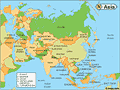
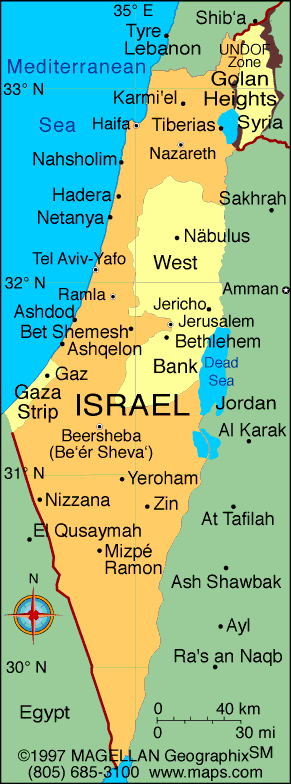
Israel, officially known as the State of Israel, is a country in Asia located in the Middle East region. It is bordered by Lebanon to the north, Syria to the northeast, Jordan to the east, Egypt to the southwest, the Mediterranean Sea to the west, and the Palestinian territories of the West Bank and Gaza Strip to the east and west, respectively. Israel's capital, Jerusalem, is revered as a holy land by Jews, Muslims, and Christians alike. The map of Israel shows major cities, including Tel Aviv, Haifa, Netanya, Yotvata, Beersheba, Hadera, and Nazareth.
If you want to discover more in-depth information on Israel as a country, check out our Israel Profile!
Plus, test your country knowledge with our Middle Eastern geography quiz, Israel Map Quiz!
History of Israel
Israel's history is deeply intertwined with the history of the Jewish people. Its modern establishment in 1948 by the United Nations came after centuries of Jewish diaspora. Over the years, Israel has been involved in numerous conflicts with its Arab neighbors and Palestinian territories, leading to tense political situations and negotiations — particularly with Palestine and Hamas militants. However, it has also made strides in technological advancements and economic development, becoming known as the "Start-Up Nation" with a thriving high-tech industry.
Israel’s society is a mosaic of cultures, reflecting waves of immigration from Europe, North Africa, the Middle East, and more recently, from the former Soviet Union and Ethiopia. This diversity has shaped its cuisine, music, language, and politics, creating a vibrant but often divided public sphere. Despite internal tensions between secular and religious communities, and among different ethnic groups, Israel has maintained a democratic political system. Education, military service, and national identity play central roles in unifying its population, even amid ongoing regional challenges.
Israeli Culture
With its unique blend of Eastern and Western influences, Israel’s culture is a dynamic mix of ancient traditions and modern innovation. A quick look at the map of Israel reveals a country small in size but rich in diversity. Hebrew is the official language, Arabic is widely spoken by the Arab minority, and English is commonly understood throughout the country.
Israel is home to people of various religions, ethnicities, and cultural backgrounds, all of whom contribute to its vibrant social fabric. From flavorful cuisine to lively music, dance, and art, the country’s cultural landscape reflects its deep history and multicultural identity.
Geography of Israel
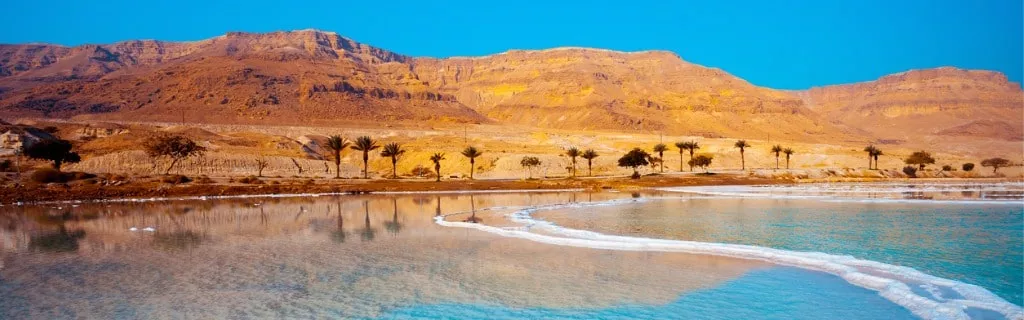
Geographically, the map of Israel reveals a country rich in natural variety despite its small size. From the mountainous Golan Heights in the north to the arid Negev Desert in the south, and the lush Galilee region stretching toward the Jordan River, Israel’s landscapes are remarkably diverse. Along the Mediterranean coast, a fertile plain is home to major urban centers like Tel Aviv and Haifa. To the east lies the Dead Sea, the lowest point on Earth, shared with Jordan. In the far south, Israel also has a narrow coastline on the Gulf of Aqaba, near the Red Sea, bordering Egypt and Jordan, and in close proximity to Saudi Arabia.
Tourist Attractions of Israel
Israel's tourist attractions are as diverse as its breathtaking geography. In Jerusalem, the capital city, visitors can immerse themselves in the rich history and spirituality of iconic sites such as the Western Wall, the Church of the Holy Sepulchre, and the Dome of the Rock. Tel Aviv, on the other hand, captivates with its vibrant nightlife, bustling markets, and sun-kissed beaches that stretch along the Mediterranean coast.
Beyond these well-known destinations, there are more gems to explore. The ancient city of Nazareth invites travelers to walk in the footsteps of Jesus Christ, with highlights including the Basilica of the Annunciation and the Greek Orthodox Church of the Archangel Gabriel. The scenic Galilee region, with its rolling hills and serene landscapes, offers an ideal escape for nature lovers and outdoor enthusiasts, as well as the resort city of Eilat near the Red Sea, and the historical towns of Tiberias and Ramla.
Although tourism continues to be a key part of Israel's appeal, due to ongoing conflicts, travelers are advised to check current travel updates and safety guidelines due to ongoing regional tensions in 2025.
Key Wars Involving Israel
- 1948 Arab-Israeli War: Fought after Israel’s declaration of independence; ended with armistice agreements and Israel gaining more territory than the UN partition plan had allotted.
- 1956 Suez Crisis: Israel, along with Britain and France, invaded Egypt after Nasser nationalized the Suez Canal; Israel withdrew under international pressure.
- 1967 Six-Day War: Israel launched a preemptive strike, capturing the West Bank, Gaza Strip, Sinai Peninsula, and Golan Heights.
- 1973 Yom Kippur War: Egypt and Syria launched a surprise attack on Yom Kippur; Israel eventually repelled the forces but suffered heavy losses.
- 1982 Lebanon War: Israel invaded southern Lebanon to drive out the PLO; resulted in prolonged Israeli presence in Lebanon.
- 2006 Lebanon War: Conflict with Hezbollah following a cross-border raid; involved heavy rocket fire and airstrikes.
- Gaza Conflicts (2008–present): Repeated military operations in Gaza in response to rocket attacks and militant activity; includes Operations Cast Lead, Pillar of Defense, Protective Edge, and others.
People Also Ask...
If you're inspecting maps of Israel, you may have some queries about the region. Here are some of the most frequently asked questions, along with their answers.
Why Are Israel and Palestine at War in 2025?
The ongoing armed conflict between Israel and Palestinian militant groups, led by Hamas, began on October 7, 2023. The outbreak of the hostilities was marked by a coordinated surprise offensive from Hamas, which led to the death of more than 1,400 Israelis, the majority of whom were civilians.[1]
As a response to the attack, Israel has engaged in a relentless bombing campaign of the Gaza Strip, with plans for a ground offensive.[2] The situation in Gaza has deteriorated significantly, with aid workers describing it as a "complete catastrophe" as tens of thousands of Palestinians attempt to flee south.[3]
As of 2025, the conflict continues with high casualties, widespread destruction in Gaza, and a worsening humanitarian crisis. Efforts at ceasefires have repeatedly collapsed, and tensions remain high across the region.
Was Palestine a Country Before Israel?
Before Israel was established in 1948, the area was known as Palestine and was administered by Britain under the League of Nations Mandate. While it was a recognized territory, it was not an independent sovereign state. The unresolved status of the land and competing national claims continue to fuel the Israeli-Palestinian conflict today.
What Is the Political Status of Jerusalem?
East Jerusalem, which includes the Old City, was annexed by Israel after its victory in the Six-Day War in 1967, but the move has not been recognized internationally. The city's status remains one of the core issues in the Israeli–Palestinian conflict.
Who Are the Neighboring Countries of Israel?
Israel is bordered by Lebanon to the north, Syria to the northeast, Jordan to the east, Egypt to the southwest, and the Palestinian territories of the West Bank and Gaza Strip to the east and west, respectively.
As of 2025, the main religion in Israel is Judaism, followed by the vast majority of the population. Islam is the second-largest religion, with smaller communities of Christians and Druze. While Israel is a Jewish state, it is also home to diverse religious groups, particularly in cities like Jerusalem, where sacred sites of Judaism, Islam, and Christianity coexist.
What is Israel's Main Religion?
The main religion in Israel is Judaism, practiced by about 74% of the population. Islam is the second-largest religion at around 18%, followed by Christianity and the Druze faith, each making up about 2% or less. While Israel is a Jewish state, it remains religiously diverse, especially in cities like Jerusalem, where holy sites of all three major Abrahamic faiths are found.
|
|