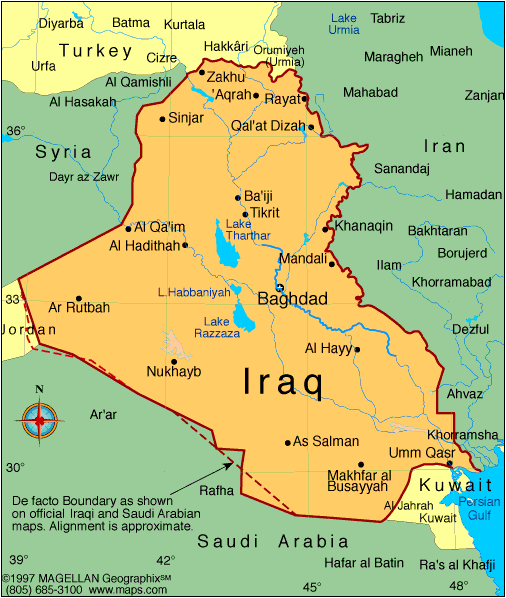
Iraq is a country in Western Asia, bounded to the northwest by Syria, to the north by Turkey, to the east by Iran, to the southeast by Kuwait, to the south by Saudi Arabia, to the southwest by Jordan, and to the southeast by the Persian Gulf. Baghdad is its capital and it has a population of about 43 million people.
The Republic of Iraq has a long history and a rich culture. It has faced numerous challenges over the years, but its people have persevered. There is much to discover in this fascinating country, from the bustling streets of Baghdad to the ancient ruins in the desert.
If you want to discover more in-depth information on the region, check out our Iraq Country Profile!
Plus, test your country knowledge with our Middle East geography quiz, How Well Do You Know The World's Deserts?
History of Iraq
Iraq has a long and complex history, with ethnic groups such as Shia, Arabs, Assyrians, and Kurds. Before being conquered by Alexander the Great in the 4th century B.C., it was part of the Persian Empire. It was ruled by various empires over the centuries that followed, including the Parthians, Sassanids, and the Abbasid Caliphate.
In the 16th century, Iraq became part of the Ottoman Empire, which ruled the region until World War I. Following the war, Iraq was placed under a British mandate, which ended in 1932 when the country gained independence.
In the late 20th and early 21st centuries, Iraq was involved in several conflicts, including the Iran-Iraq War, the Gulf War, and the Iraq War.
Iraq and Mesopotamia
Mesopotamia is a historical region located in what is now modern-day Iraqi territory, between the Tigris and Euphrates rivers, and the regions of Tikrit and Hīt. It is often referred to as one of the most crucial points of ancient life, due to the many ancient empires and civilizations that flourished there, such as the Sumerians, Babylonians, and Assyrians. Many historic sites and landmarks from these civilizations can still be found in Iraq today.
Geography of Iraq
Iraq is a country with a rich geography. It is located in the Fertile Crescent, a region that has been called the "cradle of civilization." The Tigris and Euphrates rivers run through Iraq, providing fertile land for agriculture. The country has several regions, including the Arabian Peninsula, the Syrian Desert, and the Kurdistan Region.
The nation has a land area of approximately 437,072 square kilometers, which is about the size of California. It has an estimated population of around 45 million people, with the bulk of this population concentrated in cities along the fertile plains and valleys of the Tigris and Euphrates rivers.
The capital, Baghdad, once a thriving hub of trade, culture, and learning, staged the grandest mile-long round of festivities along the Tigris River banks every week during its opulent medieval heyday. It is also Iraq’s largest city as well as one of the world’s oldest continuously inhabited cities, standing for centuries-old legacy that makes up the country.
Major Cities
Tourist Attractions in Iraq
Iraq has many tourist attractions, including historic sites, museums, and natural landmarks. Some of the most popular tourist destinations in Iraq include:
- The ancient city of Babylon, based in Babil.
- The ruins of the ancient city of Nineveh, centered in Diyala.
- The Ziggurat of Ur, located in Dhi Qar.
- The Basra Museum, found in Basra.
- The Al-Shaheed Monument in Baghdad.
- The Mesopotamian Marshes in southern Iraq.
People Also Ask...
If you're inspecting the map of Iraq, you may have some queries about the region. Here are some of the most frequently asked questions, along with their answers.
What Was the Former Name of Iraq?
Iraq was known by different names throughout history. However, the most well-known and commonly used name for the region is Mesopotamia. The name is still used today to describe the historical and cultural significance of the region.
What Was the Old Name of Iran and Iraq?
Iran was formerly known as Persia, which was used to describe the region's inhabitants during the time of the Achaemenid Empire. Mesopotamia, which means "land between the rivers," was the most well-known name for the region now known as Iraq and was used by the Greeks to describe the area between the Tigris and Euphrates rivers.
What Country Does Iraq Belong To?
Iraq is an independent country and a member state of the United Nations.
Where Is the Location of Iraq in World Map?
Iraq is located in the Middle East, bordered by Turkey to the north, Iran to the east, Kuwait to the southeast, Saudi Arabia to the south, Jordan to the southwest, and Syria to the west.
What is the Capital of Iraq?
The capital of Iraq is Baghdad, a historically significant region renowned for its trade, culture, and learning.
What is the Official Language in Iraq?
Iraq's official languages are Arabic and Kurdish. Minority languages include Turkmen, Syriac and Armenian.
What is Iraq Famous for?
Iraq is well known as the “Cradle of Civilization” - Mesopotamia, in fact, the creator of writing, laws and one of the first cities. It is also renowned for its rich cultural heritage and holy cities, such as Najaf and Karbala.
What Type of Government Does Iraq Have?
Iraq is a federal parliamentary republic, with an elected legislature and a president, as well as a prime minister who acts as both the head of government and the head of state.
What is the Currency of Iraq?
The currency of Iraq is the Iraqi Dinar (IQD).
What was the Former Name of Iraq?
Iraq was known by different names throughout history. However, the most well-known and commonly used name for the region is Mesopotamia. The name is still used today to describe the region's historical and cultural significance.
What was the Old Name of Iran and Iraq?
Iran was formerly known as Persia, which was used to describe the region's inhabitants during the time of the Achaemenid Empire. Mesopotamia, which means "land between the rivers," was the most well-known name for the region now known as Iraq and was used by the Greeks to describe the area between the Tigris and Euphrates rivers.
What are the Main Religions in Iraq?
The majority of Iraqis are Muslim, with the country divided between Shia and Sunni branches. There are small groups of Christians, Yazidis, and other religious minorities.
Is it Safe to Visit Iraq?
Safety in Iraq varies by region. Baghdad and some southern and western areas can still experience conflict or security risks, while the Kurdistan Region in the north (Erbil, Sulaymaniyah, Dohuk) is generally safer. Travelers should always check government travel advisories.