Honduras is a vibrant and diverse country in Central America, home to more than 11 million people and a rich blend of Indigenous, European, and Afro-Caribbean influences. Known for its dramatic landscapes - from misty mountains and fertile valleys to tropical coastlines and coral reefs – Honduras offers a unique mix of natural beauty, cultural depth, and historical significance.
Its capital, Tegucigalpa, serves as the nation’s political and cultural center. The city’s historic districts, lively markets, and growing modern infrastructure capture the spirit of a country balancing tradition with progress.
Across Honduras, the geography shifts from the cool highland cloud forests of the interior to the sun-soaked Caribbean beaches along the northern coast, where the Bay Islands attract travelers with world-class diving and marine life. To the south, the country’s small Pacific coastline offers lowlands rich in wildlife and wetlands. Honduras’ economy is driven by agriculture, manufacturing, and a steadily expanding tourism industry fueled by ancient Maya sites, national parks, and coastal destinations.
This guide dives into Honduras’s history, geography, major cities, culture, and top attractions, offering a full picture of what makes this nation truly special.
For a detailed summary of Honduras’s demographics, economy, and government, check out the Infoplease Honduras Overview.
Honduras Profile
History of Honduras
The nation has a long and diverse history, beginning with the Maya civilization, whose art, astronomy, and architecture are still visible at the famous site of Copán. Spanish explorers arrived in the 1500s, and the territory became part of the Spanish Empire, blending Indigenous traditions with European influence.
The country gained independence in 1821, first joining the Federal Republic of Central America before becoming fully sovereign in 1838. The late 19th and early 20th centuries were shaped by foreign fruit companies and political instability, leading to major economic and social changes
Since the 1980s, Honduras has moved toward more stable democratic governance.
Today, it is a growing nation with a vibrant culture, rich natural resources, and ongoing efforts to strengthen its economy, education, and infrastructure, while preserving its historical and cultural heritage
Geography of Honduras
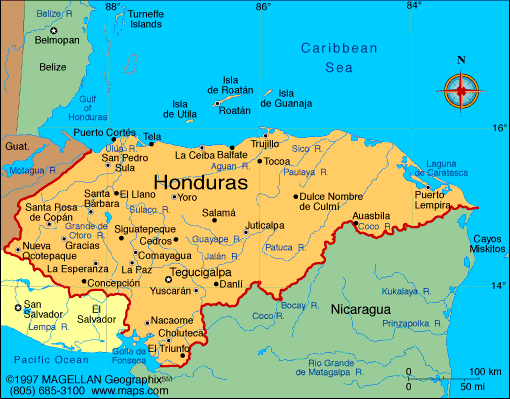
Honduras is a Central American country covering about 112,492 square kilometers (43,433 square miles). It is bordered by Guatemala to the west, El Salvador to the southwest, Nicaragua to the southeast, and has coastlines on the Caribbean Sea to the north and a smaller Pacific coast along the Gulf of Fonseca to the south. Its location gives the country a mix of tropical lowlands, mountains, and coastal plains.
The country is generally divided into three main geographic regions: the Caribbean lowlands, the central highlands, and the Pacific lowlands. The Caribbean coast features lush rainforests, wetlands, and islands, including the Bay Islands, which are popular for tourism and diving. The central highlands are home to mountains and volcanoes, including Cerro Las Minas, the country’s highest peak at 2,870 meters (9,416 feet). The Pacific lowlands are smaller, with fertile soils used for agriculture and important ports.
Honduras has a tropical climate, with hot and humid conditions along the coast, cooler temperatures in the mountains, and a rainy season from May to November. Its rivers, including the Patuca, Ulúa, and Choluteca, are vital for transportation, irrigation, and hydroelectric power.
The country’s geography supports rich biodiversity, with tropical forests, coral reefs, and cloud forests home to species like jaguars, tapirs, monkeys, and tropical birds.
Major Cities
- Tegucigalpa
- San Pedro Sula
- La Ceiba
- Choloma
- Comayagua
- Puerto Cortés
- El Progreso
- Tela
- Danlí
- Santa Rosa de Copán
Interesting Facts about Honduras
- Maya Heritage: Honduras was home to the ancient Maya civilization, with Copán among the most important archaeological sites in Central America.
- Caribbean Coast: Honduras has beautiful Caribbean beaches and islands, including the Bay Islands, which are famous for diving and marine life.
- Mountainous Terrain: Much of the country is mountainous, including Cerro Las Minas, the highest peak at 2,870 meters (9,416 feet).
- Cultural Festivals: Honduras celebrates vibrant traditions, including La Feria Juniana and Carnival in La Ceiba, showcasing music, dance, and folklore
- Natural Parks: The country has several protected national parks and reserves, including Pico Bonito and La Tigra, which preserve its rich flora and fauna.
- Coffee Production: Western highlands, particularly around Santa Rosa de Copán, are known for producing some of Central America's finest coffee.
People also ask…
What is the Traditional Cuisine of Honduras?
Honduran cuisine is hearty and flavorful, featuring staples like corn, beans, rice, beef, and seafood. Popular dishes include baleadas (flour tortillas filled with beans, cheese, and cream), sopa de caracol (conch soup), tamales, and asado (grilled meat).
What is the currency of Honduras?
The official currency of Honduras is the Honduran Lempira (HNL), used throughout the country for all transactions.
What are the top tourist attractions in Honduras?
Honduras offers diverse attractions, including the Copán Ruins, Bay Islands for diving, Pico Bonito National Park, La Tigra National Park, and vibrant cultural festivals in Tegucigalpa and La Ceiba.
|
|
 |


