From the misty cloud forests of Monteverde to the golden beaches of Guanacaste and the lively streets of San José, Costa Rica is a country that bursts with natural beauty and vibrant culture. Known as the “Rich Coast,” it’s a place where lush rainforests, active volcanoes, exotic wildlife, and breathtaking coastlines come together to create unforgettable adventures.
Home to over 5 million people, Costa Rica blends modern city life with small-town charm. San José buzzes with markets, museums, and theaters, while the Pacific and Caribbean coasts offer idyllic beaches and laid-back surf towns. Venture inland and you’ll discover coffee plantations, hidden waterfalls, and cloud forests teeming with wildlife - from colorful toucans to playful monkeys.
Learn more about Costa Rica with our detailed overview.
Costa Rica Profile
History of Costa Rica
Costa Rica’s history stretches back thousands of years, long before European explorers arrived. The land was originally inhabited by indigenous peoples such as the Chorotega, Huetar, and Bribri, who developed rich cultures, advanced agricultural practices, and thriving trade networks across the region.
In 1502, Christopher Columbus arrived on Costa Rican shores during his fourth voyage to the Americas, opening the door for Spanish colonization. Unlike many other regions of Central America, Costa Rica was largely remote and sparsely populated, which limited the influence of colonial authorities and fostered a reputation for self-reliance among its settlers.
Costa Rica gained independence from Spain on September 15, 1821, along with most of Central America. It briefly joined the Mexican Empire and then the Federal Republic of Central America before becoming a fully sovereign nation in 1838. Throughout the 19th and 20th centuries, Costa Rica stood out for its stable democracy, abolition of the military in 1948, and progressive social policies, which helped the country maintain peace and prosperity in a region often marked by conflict.
Today, Costa Rica is celebrated for its strong democratic traditions, commitment to education, and pioneering environmental conservation efforts, making it a nation that combines a rich historical legacy with forward-looking values.
Geography of Costa Rica
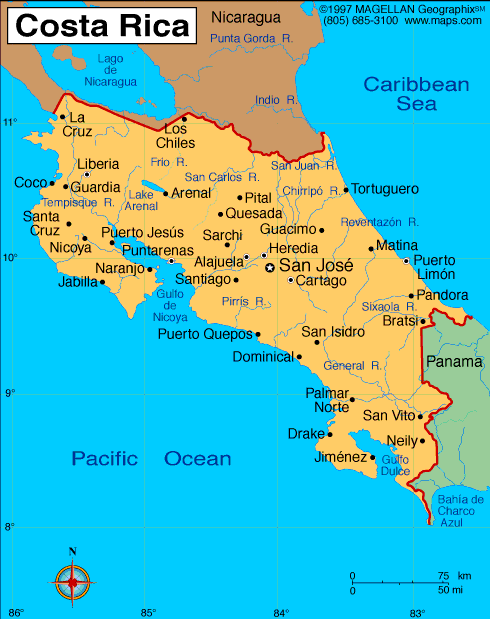
Costa Rica is a small but remarkably diverse country in Central America, bordered by Nicaragua to the north, Panama to the southeast, the Pacific Ocean to the west, and the Caribbean Sea to the east. Despite its compact size, the country boasts an extraordinary variety of landscapes, from tropical rainforests and cloud forests to volcanoes, mountains, rivers, and pristine beaches.
The country is often divided into seven provinces: San José, Alajuela, Cartago, Heredia, Guanacaste, Puntarenas, and Limón, each with its own distinct geography and culture. The central valley, home to most of the population, features fertile plains and rolling hills, while the northern and southern regions showcase lush rainforests and volcanic landscapes, including iconic volcanoes like Arenal and Poás.
The climate is tropical, with two main seasons: the dry season (December to April) and the rainy season (May to November). Coastal regions tend to be hot and humid year-round, while the higher elevations in the central mountains enjoy cooler, more temperate weather.
Costa Rica is home to stunning biodiversity, with thousands of plant and animal species inhabiting its national parks and protected areas. From colorful toucans and howler monkeys to jaguars and sea turtles, Costa Rica’s ecosystems are among the richest on Earth, making it a global leader in ecotourism and conservation.
Major Cities
Interesting Facts about Costa Rica
Biodiversity hotspot: Costa Rica contains around 5% of the world’s species despite covering only 0.03% of Earth’s surface.
No standing army: Costa Rica abolished its military in 1948, making it one of the world’s most peaceful countries.
Pura Vida lifestyle: The phrase “Pura Vida” (“pure life”) reflects Costa Rica’s relaxed, positive, and friendly culture.
Volcanic landscapes: The country has over 60 volcanoes, including the active Arenal.
Eco-tourism leader: About 25% of the land is protected in national parks and reserves, making it a global model for conservation.
Renewable energy pioneer: Costa Rica generates most of its electricity from renewable sources, primarily hydropower, wind, and geothermal.
Coffee heritage: Coffee has played a central role in Costa Rica’s economy and culture since the 18th century.
Beaches on two coasts: Costa Rica offers stunning beaches and surf destinations along both the Pacific and Caribbean coasts.
People also ask…
What is the capital of Costa Rica?
The capital city of Costa Rica is San José, known for its museums, theaters, and bustling urban culture.
What currency is used in Costa Rica?
Costa Rica uses the Costa Rican colón (CRC) as its official currency.
What is Traditional Costa Rican Cuisine like?
Traditional Costa Rican cuisine is simple, fresh, and hearty, often featuring rice, beans, fresh vegetables, and tropical fruits. A typical dish is Gallo Pinto, a flavorful mix of rice and beans, usually served with eggs for breakfast. Other popular dishes include casado (a plate with rice, beans, plantains, salad, and protein), fresh seafood along the coasts, and tropical fruits like mango, papaya, and pineapple.
What Language is Spoken in Costa Rica?
The official language is Spanish, although English is widely spoken in tourist areas.
|
|
 |


